In my last blog, we analysed how the ruling dispensation is more comfortable now than it was six months ago, primarily due to the implosion within two main opposition parties - Congress and the RGP. The public-spirited agitations have waned, and those taking to the streets have motives other than the greater public good.
From movements uniting us as Goans to protect our land and environment, we are spiralling into protests that divide us and do not improve our standard of living.
Caste divisions:
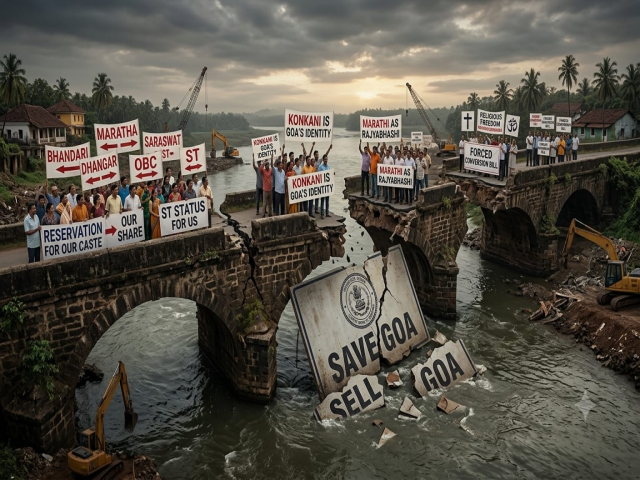
Since ST reservation entered our discourse, we have started identifying ourselves with caste labels. From Bhandaris to Marathas and from Dhangars to Saraswats, our conversation has shifted from what Goa needs to what our caste requires to amass a larger share in the power pie.
ST reservation was probably a trigger. The community is getting what the Constitution of India guarantees them. However, the upending political equations inspired many caste-based groups to push for a similar kind of reservation. That set off a chain reaction. Dhangars were eager to be recognised as ST. OBCs wanted political reservation. Marathas were demanding implementation of the ST reservation after the ongoing census, and so on.
Most of us started feeling a sense of belonging more towards our particular caste rather than our beloved Goa.
Language divisions:
Suddenly, one of the Mandovi bridges got blocked because supporters of Marathi want it declared as ‘rajyabhasha’. This age-old issue, mainly spearheaded by senior citizens, intensified like it does every time elections come closer. It is primarily emotive and makes no difference in our daily life. In fact, it may end up making our job-seeking opportunities difficult. Goans have preference in government jobs right now because of ‘knowledge of Konkani’. What happens if Marathi gets the same privilege? Marathi has mighty Maharashtra for its upliftment and development. Konkani has this tiny state struggling to keep it afloat amidst the onslaught of English. Marathi also faces the same challenge in Maharashtra.
But this inconsequential issue has suddenly become a mainstream discussion on social media. After caste-based identity battles, we are now arguing with each other as protagonists of Konkani and Marathi. Konkani supporters are writing in Marathi newspapers to rally their point; Marathi sentimentalists are giving sound bites in Konkani to emphasise their view, and the rest of the interested parties are quarrelling on Facebook in English. Although it sounds amusing, it is a grave situation. Goa is once again on the back burner, and language identity is at the forefront.
Religious divisions:
A bogey of an ‘anti-conversion’ bill proposed by the government to be presented in the assembly and later withdrawn after tremendous pressure from the minority community MLAs belonging to the ruling party once again exposed our communal fault lines.
Most of the citizenry truly believed that the bill was an unnecessary exercise aimed at dividing society by creating a futile but politically potent narrative to incite communal sensibilities. Catholic MLAs from either side of the aisle stepped ahead and vehemently opposed this bill. Hindu MLAs were silent till the end. Opponents of the bill believed that although forced religious conversions are bad, this bill would be weaponised against certain elements rather than fulfilling its stated purpose. Supporters of the draft legislation argued that why should only MLAs from the minority community have a problem with it?
Thankfully, better sense prevailed, and the government decided not to table the bill in the House. But the chorus around the controversy revealed our shortcomings. We can be easily provoked, dragged into communal discourse and pushed into an abyss of insecurity.
Rather, all of the above instances proved just that. Elections are less than six months away, and we can expect more such attempts to distract, divide and debase us. It will serve the powers that be if our attention shifts from the protection of Goa to the preservation of our caste identity, from the prosperity of Goa to the protests for our language identity and from an inclusive, harmonious idea of Goa to an acrimonious, combative idea of our religious identity. It will serve them well. The question is: will it serve us, and will it benefit the future of our youth and children?