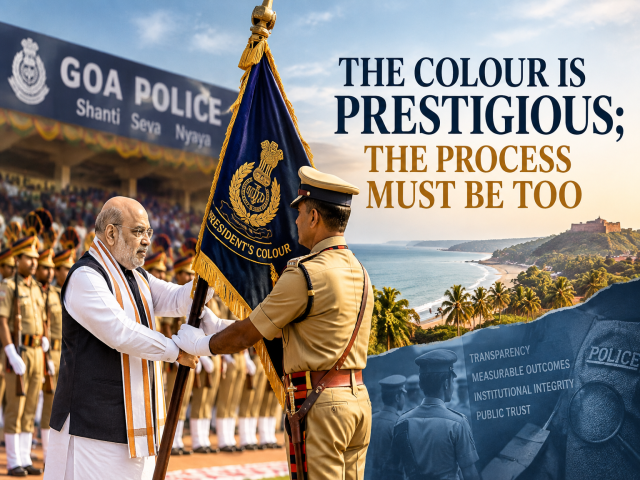
The President’s Colour, popularly known as Rashtrapati ka Nishan, is a prestigious institutional honour conferred on police forces and other disciplined forces in recognition of exceptional service. The honour symbolises national recognition of courage, excellence and distinguished service. The Ministry of Home Affairs’ current guidelines describe it as an honour that recognises achievements in areas including combat, humanitarian operations, training and infrastructure.
The Indian Navy was the first armed force to receive the President’s Colour, in 1951, and the tradition subsequently extended to state police forces. Uttar Pradesh received it in 1952, followed by Delhi Police and Maharashtra Police. Madhya Pradesh, Nagaland, Jammu and Kashmir, Tripura and, subsequently, several other state forces were also honoured.
For Goa Police, therefore, the presentation of the President’s Colour is undoubtedly a moment of pride. The ceremony at the Shyama Prasad Mukherjee Indoor Stadium, with Union home minister Amit Shah presenting the Colour on behalf of the President, marks an important milestone for the force.
But an honour of this stature should also invite some reflection on the institution receiving it. Goa Police has a history that predates Liberation. The Polícia do Estado da Índia (PEI) was established by the Portuguese regime in April 1946. Until then, policing, including maintenance of law and order, was carried out by the Portuguese military. The PEI subsequently became heavily involved in containing the freedom movement, particularly after Dr Ram Manohar Lohia’s civil disobedience movement in 1946. Goa Police’s own history records that the force later acquired notoriety for its brutal repression of the freedom movement.
Following Liberation on December 19, 1961, Goa Police underwent a fundamental transformation. N R Nagu became the first Inspector General of Police of free Goa, while policing systems based on Indian laws and procedures were introduced. A major reorganisation followed the recommendations of B Shetty, Additional DGP in the CBI, after his 1965 study of the force.
I had the privilege of serving alongside some of the old-timers who joined during that transition. When I entered the service, many were nearing retirement. I found them disciplined, dedicated and deeply loyal to their uniform. They belonged to a very different era of policing, but their commitment to the force left an impression.Over the years, Goa Police has undergone tremendous change in its functioning and public interface. It has worked towards becoming more people-friendly and community-oriented. Its motto, Shanti, Seva, Nyaya, reflects the ideal of a police force that serves the citizens.
Why Goa Police received the honour
The reasons cited for the honour include policing excellence, modernisation and infrastructure, specialised security capabilities and public-safety initiatives. These include improvements in law-enforcement infrastructure and forensic capabilities, adoption of modern technology, coastal security, intelligence and anti-narcotics operations, and initiatives such as the Pink Force aimed at women's safety.
These are all important areas of policing. Yet I find the justification somewhat uninspiring unless these claims are supported by measurable outcomes.
Take the Pink Force. It is a welcome initiative, but its introduction alone cannot establish its success. What has been its measurable outcome? How many cases has it handled? How effectively has it responded to citizens? What has been the public response? These are questions that should be answered before a relatively new initiative is held up as evidence of policing excellence.
The same scrutiny should apply to modernisation and technology. Infrastructure, forensic facilities and sophisticated equipment are useful only if they translate into better investigation, faster justice and greater public confidence. Similarly, coastal security, intelligence and anti-narcotics operations are vital for Goa, but their effectiveness should ultimately be judged by outcomes.
This is not to belittle the achievements of Goa Police. It is to suggest that an honour of this stature should be accompanied by a clear account of what distinguished the force and why it was considered worthy at this particular point in time.
The MHA’s 2025 guidelines are a welcome development. They lay down eligibility requirements and measurable indicators covering police-public ratio, women’s representation, public safety, technology, training, welfare and major achievements.
Yet the expanding list of recipients also raises questions about the exclusivity and transparency of the honour.
A closer look at recent awards does not establish a clear pattern of political or election timing.
Gujarat received the Colour in 2019, Himachal Pradesh in 2021, Assam and Tamil Nadu in 2022, Haryana in 2023 and Chhattisgarh in 2024. The dates do not consistently coincide with Assembly elections: some awards preceded elections, while others followed them. I make no allegation that electoral considerations influenced any of these decisions. My concern is different. When an honour is meant to recognise professional excellence, the public should be able to see clearly what distinguishes one police force from another and why the honour was conferred at a particular time.
I do not grudge these forces their recognition. Many have produced outstanding officers and demonstrated exceptional courage, professionalism and innovation. My grievance is with a system in which the comparative basis for selection is not sufficiently visible. Greater transparency would strengthen the prestige of the President’s Colour rather than diminish it.
As I have written before, there is always a danger of “an inability to separate the wheat from the chaff or the failure to distinguish between quality and mediocrity”.
For Goa Police, however, this remains an occasion to celebrate. From its difficult beginnings in 1946 and the transformation following Liberation, the force has come a long way. Generations of officers and personnel have served Goa, and several have made their mark at the national level.
The honour belongs not merely to those occupying positions today, but to the generations of policemen and women who built the institution and served it through difficult periods of transition.
As a retired IPS officer, I was honoured to have been invited to the presentation ceremony. I attended the function alongside my former colleagues and saluted those currently serving. I must say the ceremony was impressive, and the force showcased an excellent parade.
The challenges facing today's police are more complex than those we confronted during my service. Criminality can be tackled through better training, technology, investigation and professional policing. The more difficult challenge is maintaining institutional integrity while working within the political and administrative system.
I remain proud of the khaki I once wore. I was once a citizen in uniform; today I remain a policeman without the uniform—a citizen who still believes in the service.
The President’s Colour should not merely be a decorative addition to the uniform. It should be a reminder of the standards the force must continually strive to uphold: Shanti, Seva, Nyaya. If Goa Police can live up to those words, the honour will mean far more than a ceremonial flag.