The growing controversy over loudspeakers, DJs and high-volume music during festivals in Maharashtra should serve as a warning for Goa.
Across Maharashtra, the use of powerful DJ systems and loud music during religious processions and celebrations has increasingly become a matter of public debate. The issue is not about opposing festivals or religious celebrations. The real question is whether the celebration of one community or group should come at the cost of the peace, health and well-being of others.
For Goa, this debate is particularly relevant.
Goa is known not only for tourism and nightlife, but also for its rich cultural and religious traditions. However, the growing influence of party culture and high-volume DJ music is changing the way several festivals and public celebrations are conducted.
From Gokul Ashtami to Ganesh Visarjan
Festivals such as Gokul Ashtami, Ganesh Chaturthi and Narkasur Dahan are deeply rooted in Goan culture. Traditionally, these occasions were centred around community participation, devotional music, rituals and local traditions.
Today, in some places, DJs and powerful sound systems have become a major part of celebrations.
The same trend can also be seen during Ganesh immersion processions, where the volume of music can sometimes become more important than the cultural or devotional character of the event.
Similarly, during Narkasur celebrations, competitions and public gatherings are increasingly accompanied by amplified music and DJ systems.
And then there is the growing culture of year-end parties, where high-volume music is often considered an essential part of entertainment.
The question Goa needs to ask is simple:
Are we celebrating our festivals—or simply competing to see who can produce the loudest sound?
The role of the Goa State Pollution Control Board
The issue of noise pollution cannot be ignored simply because it happens during a festival.
The Goa State Pollution Control Board (GSPCB) has the responsibility of monitoring environmental pollution, including noise pollution, and taking action when prescribed standards are violated.
Noise pollution rules already provide a legal framework governing loudspeakers, public-address systems and permissible noise levels. Restrictions are particularly important during night hours.
Therefore, enforcement should not be viewed as an attempt to stop festivals.
Rather, effective enforcement can help ensure that festivals are celebrated without creating unnecessary disturbance for residents.
There is also a need for better public awareness. Many people may not understand that excessive noise can affect sleep, concentration and general well-being, particularly for children, senior citizens, students and people who need a peaceful environment.
The Maharashtra lesson
The controversy in Maharashtra demonstrates how the issue can quickly become a conflict between different sections of society.
On one side are festival organisers and young people who see DJ music as part of modern celebration.
On the other are residents, environmental activists and citizens who demand compliance with noise regulations.
Goa should avoid reaching the same stage.
Instead of waiting for conflicts, complaints, police intervention and court cases, the State can encourage dialogue between organisers, local communities, authorities and environmental agencies.
Does Goa really need DJs for every festival?
This is where Goa has a unique advantage.
Goa already has a rich musical and devotional tradition that can provide alternatives to extremely loud DJ systems.
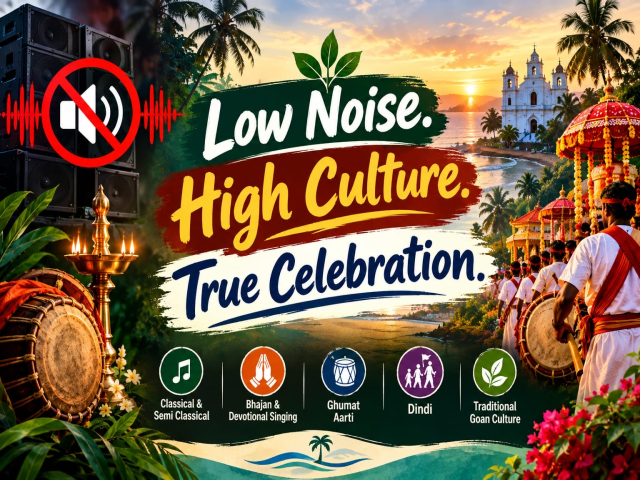
Our celebrations can include:
Classical and semi-classical music
Bhajans and devotional programmes
Ghumat Aarti
Dindi processions
Traditional Goan instruments
Abhang and devotional singing
Community singing and cultural programmes
A Ghumat Aarti, for example, can create an atmosphere of devotion and community participation without requiring enormous sound systems.
Similarly, a Dindi can bring people together through music, rhythm and devotion while preserving the cultural character of the festival.
These are not outdated traditions.
They can become the modern alternatives to excessive DJ culture.
Party culture and Goa's identity
Goa has always welcomed music, entertainment and nightlife. There is nothing wrong with that.
The problem begins when entertainment becomes synonymous with uncontrolled volume.
A party does not have to disturb an entire neighbourhood to be successful.
A festival does not become more meaningful because its speakers are louder.
And a procession does not become more energetic simply because the sound system is operating at maximum volume.
Goa can find a balance between tourism, entertainment, tradition and environmental responsibility.
Towards a “Low Noise, High Culture” Goa
Instead of asking whether DJs should be completely banned, Goa should consider a more practical approach.
Regulate the volume.
Respect permitted timings.
Monitor noise levels.
Protect residential areas.
And promote traditional cultural performances.
Authorities can work with festival committees to create designated sound zones and ensure that sound levels remain within permitted limits.
At the same time, cultural organisations can be encouraged to bring traditional music, Ghumat Aarti, Bhajans, Dindi and classical performances back to the centre of public celebrations.
The objective should not be to kill the spirit of the festival.
It should be to preserve the spirit while reducing the noise.
The choice before Goa
Maharashtra's continuing sound-pollution controversies offer Goa an opportunity to learn before the issue becomes a larger social conflict.
Goa does not have to choose between culture and modern entertainment.
It can have both.
But perhaps it is time to redefine what a successful celebration means.
A festival should be remembered for its devotion, culture, togetherness and happiness—not for how many decibels it produced.
Goa has a rich cultural heritage. It has music, rhythm, devotion and community traditions of its own.
Perhaps the future of Goan celebrations should not be:
“More DJ, more volume.”
Instead, it could be:
“Low Noise. High Culture. True Celebration.”