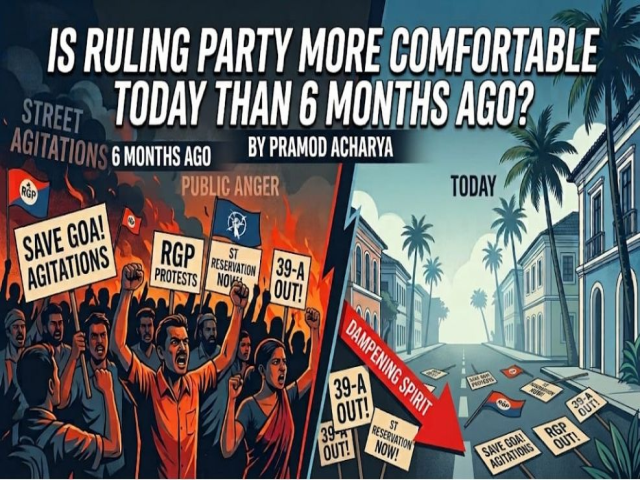
6 months ago, Goa was simmering with anger—agitations on the streets, PILs in the courts, civil movements in the halls, and whatnot. Now, the anger persists, but the streets are quiet, the steam has dissipated, and the uproar has fallen silent. What has changed in the last 6 months that has led to this change in momentum on the ground? Have we lost our focus?
In my opinion, 3 crucial changes took place during this period that led to the dampening of the agitating spirit.
Disintegration of the RGP:
The Revolutionary Goans Party was at the forefront of most of these street agitations, either through leadership or through foot soldiers. Viresh Borkar’s mega hunger-strike at the Azad Maidan sent shockwaves through the corridors of power, not only in Goa but also in Delhi. Ajay Kholkar’s role in the Chimbel Unity Mall agitation was commendable. He became one of the prominent faces of the uprising and one of the think-tanks behind the protest. RGP’s village-level workers participated in various agitations and ensured numerical strength to many protests in nooks and corners of Goa.
The party's disintegration was a fatal blow to the momentum of public outcry against the various ill-conceived policies of the state government. Nobody knows for sure why RGP suffered the fate it did. Was it because of Viresh’s agitation against 39-A? Was it because of Manoj Parab’s ego, or did some very powerful forces whose interests were hurt during these protests play their hand? No one knows for certain. But their ‘revolutionaries’ from different parts of Goa were disillusioned, and the party is still experiencing various kinds of implosions as we ponder upon this issue.
Girish Chodankar as GPCC President:
Amit Patkar was certainly not doing a spectacular job. The party, on most occasions, was in a slumber mode. The remaining 3 MLAs were not putting up a united front. Yet, there was no chaos. It was a status quo that most observers resented - no dynamism, no clear strategy and absence of cohesive behaviour between the party and the legislature wing. Somehow, the show went on.
Girish Chodankar stepped in, and chaos ensued. Another opposition party, after RGP, was imploding. Allegations of selling tickets, suspensions of some loyal party workers, Amit Patkar’s grievance that he was removed unceremoniously, and Girish’s show of strength by inviting K C Venugopal and Mallikarjun Kharge in Goa for the first time during the tenure of this assembly, muddied the waters further. The rumblings within the Congress, like in the RGP, continue.
Suddenly, two of the most prominent opposition parties in the state were in shambles. The disillusionment amongst their karyakartas was now percolating down towards their voters and the people in general.
ST Reservation:
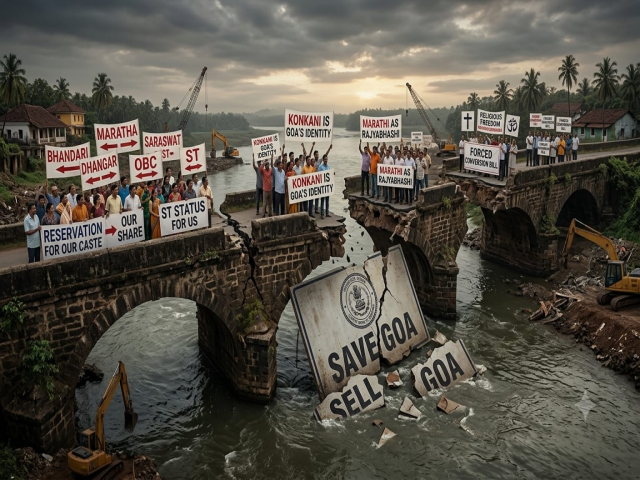
This sent everyone in a tizzy. The BJP was flustered by the aggression of their own ST MLAs and their electorate. The Congress had no clue how to respond, and the other political parties were grappling with the enormity of the decision. Once the centre set the ball rolling, the ruling party was taken aback by the offensive of their non-ST MLAs, who might lose their constituencies once the reservation comes into force.
The people too realised that the political landscape is fast changing with such momentous decisions by the BJP. Will the reservation process be complete before the 2027 assembly election? Can the process be rushed? Will the will of the ruling party overpower the rigours of the bureaucracy? No one knows as of now. However, these developments have pushed the public backlash into the state of uncertainty.
Suddenly, 39-A is no longer a part of daily conversation. The ‘Enough is Enough’ movement has failed to build a sustained campaign on the streets. Most of their battles are now in the High Court rather than in the people’s court. The Karapur-Sarvan agitation is approaching its 150th day with no solution in sight. They too have moved the High court.
Have we lost our focus? Has our intensity slipped into disarray because of the above 3 happenings? It certainly looks so. The government is expected to bend to the will of the people during the 6 months before the elections. In our case, there is a reversal of this trend. The ruling dispensation is much more comfortable today than it was in March, and it certainly doesn’t augur well for us - the people.