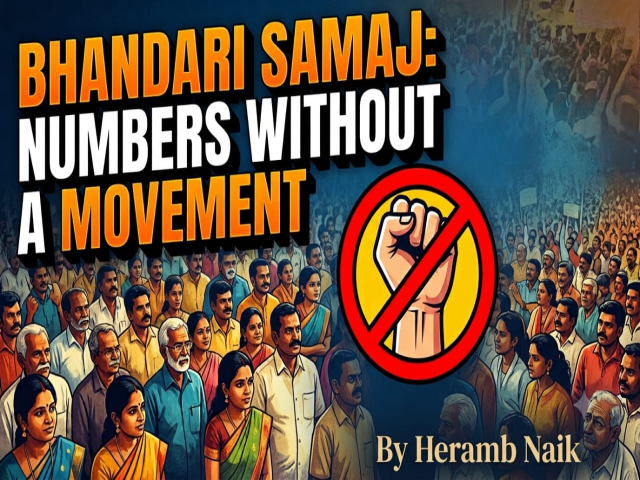
When Ravi Naik died in October 2025, the word that kept surfacing in the tributes was 'vacuum'. He had been Chief Minister, he was a serving minister at 79, and the Gomantak Bhandari Samaj buried him as the tallest leader it had. Then came the question nobody could answer. Who now? There was no successor the community had raised, no second name to reach for. In the sixty years since Liberation, by the reckoning of most people who follow Goa closely, the Bhandari Samaj has sent a long line of legislators to the Assembly and produced exactly one Chief Minister, the man they lost that week.
Sit with that for a moment, because it is strange. This is the largest community in the state. There is a line long attributed to Nehru, watching Goa refuse to behave as Delhi expected, that "Ajeeb hain Goa ke log", (the people of Goa are strange). You will not find it in his collected speeches, and careful Goa historians treat it as folklore rather than fact, so I use it only as the verdict it has become. The Bhandari story keeps re-earning it. No community this large has stayed this quiet, and the quiet is not modesty. It is the absence of a machine.
The Bhandari community is the largest of Goa's Other Backward Classes. The Goa State Commission for Backward Classes counted about 2.19 lakh Bhandaris in its 2014 survey, roughly 61 per cent of the state's OBC population. Caste is not enumerated in the regular census, so any claim to being the single largest community rests on estimates rather than a headcount, and honesty requires saying so. But the direction is not in doubt. In sheer numbers this is Goa's heaviest single community, and it carries almost none of the collective political weight that number should buy.
My argument is simple, and I think it is hard to dodge. The Bhandari Samaj is politically weak in proportion to its size because it has never done the work that builds durable power. It has never organised, never agitated, never turned its social weight into a claim that belongs to the community rather than to whichever of its sons a party decides to promote. It waits to be courted. It is courted by everyone, and being courted has been comfortable enough that the community never had to build anything of its own.
Look at how the community's own leaders actually reached power. The leaders since have been self-made men who built their own standing first and were then handed tickets by parties that could count votes. Ravi Naik came up through the MGP and made himself Chief Minister in 1991 by leading a faction into the Congress, a personal manoeuvre and not a community campaign. Shripad Naik began as a panch and a sarpanch, rose through the BJP to run its Goa unit, has held North Goa in the Lok Sabha since 1999 and sat in a Union minister's office for much of the last decade. He is the most powerful Bhandari politician alive, and he has never been made Chief Minister. Vishnu Wagh was a poet and a cultural force in the community long before the BJP gave him St Andre in 2012. Subhash Shirodkar built his own base in Shiroda and carried it from the Congress to the BJP. Damu Naik worked his way up the BJP to become its Goa president in 2025. In each case the man earned his place, the party recognised it, and then the community claimed him afterward.
Now look at the people who did the opposite.
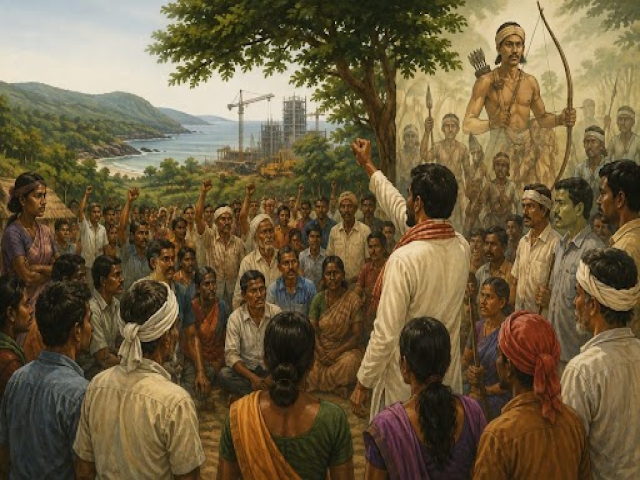
The Gawda, Kunbi and Velip fought for a generation. They are a fraction of the Bhandari Samaj's size, barely a tenth of Goa by population, and they organised anyway. The federation known as GAKUVED formed in 1980 to press for their inclusion in the Scheduled Tribes list. When that came, through the Constitution order amendment passed as Act 10 of 2003, it came after decades of organised demand, not as a gift. The United Tribal Associations Alliance formed in 2004 and kept the pressure on with rallies and a rath yatra. In May 2011 a tribal agitation at Balli in South Goa turned deadly, and two people died. They refused to stop. By 2025 they had pushed a bill through Parliament to reserve Assembly seats for Scheduled Tribes, a right Goa had never granted them, and they are now waiting only on the delimitation that will hand it over. Goa remains the only state with no political reservation for its Scheduled Tribes, and through 2026 tribal leaders have been back at Shramashakti Bhawan demanding that the seats promised to them be delivered.
Notice who that struggle produced. Prakash Velip, an MLA and the president of the tribal alliance at the same time, one foot in the movement and one in the legislature. Ramesh Tawadkar, who led the Balli agitation for ST status and went on to become Speaker of the Assembly and the state's Tribal Welfare minister. Govind Gaude, the most visible tribal voice of his generation. Ganesh Gaonkar, who took the Speaker's chair in 2025. These are not men a party discovered and elevated. They are men a movement made.
I want to be careful here, because this is where the argument is easy to get wrong. The point is not that the Bhandari community should have shed blood, or that agitation is admirable in itself. The point is narrower and, I think, harder to escape. A leader who rises from a movement carries the movement with him. His authority is the community's authority, held in trust, and it does not vanish when he does, because the organisation that made him is still standing. A leader handed a seat by a party carries the party, and when he is gone the community is back where it started, waiting for the next individual some party decides to elevate. The tribes built a claim that outlives any one man. The Bhandari Samaj built careers that ended with the men who held them.
The community has had its openings and let them close. The MGP, founded by Dayanand Bandodkar as a vehicle for the backward-class Hindu vote, was the closest thing to a party the Bahujan communities could call their own. It declined, and its base was slowly absorbed into Congress and later the BJP. Older members of the Samaj will tell you that when Bhandari leaders like KB Naik broke from the MGP, the community did not walk out behind them, and the chance to hold a bloc together passed. I cannot document that break to a citable source, so I offer it as community memory rather than record, but the outcome is visible enough. When the community has tried to act as a bloc since, it has not held.
This is the difference between social capital and political capital, and it is the whole of the matter. The Bhandari Samaj has social capital to spare. It is the largest bloc among Goa's Other Backward Classes, by its own count close to a third of the state, and it has an apex body in the Gomantak Bhandari Samaj that every party comes calling on, the way Arvind Kejriwal did when he walked into its Panaji office before the 2022 election. But social capital that is never organised does not turn into power. It becomes a resource that individual politicians draw down for their own campaigns and never repay. The tribes had far less of it and made far more of it, because they spent theirs together while the community spent its own one politician at a time.
When the Bhandari Samaj has been mobilised, it has usually been mobilised from outside, for someone else's purpose. In 2022 the Aam Aadmi Party made the most open caste pitch Goa had seen, naming the Bhandari lawyer Amit Palekar as its Chief Ministerial face. The community it was courting turned it down at the ballot, and every AAP Bhandari candidate lost, Palekar included. A demand from the Gomantak Bhandari Samaj for a 20 per cent community reservation surfaced and sank. Even Viresh Borkar, whom the Samaj embraced as one of its own in 2026, had won St Andre in 2022 on the Revolutionary Goans ticket, a nativist platform with nothing to do with caste. The community claimed him after the fact, the way it always does.
There is a fair case on the other side, and it deserves a hearing. Perhaps a community that votes across party lines instead of as a caste bloc is the healthier thing for a democracy. Perhaps influence spread through every party is its own quiet form of power, and it spares the community the ugliness of identity politics and the price the tribes paid at Balli. I take it seriously, and I would take it further if October 2025 had gone differently. When the community's tallest leader died there was no institution to inherit him, only a vacuum. Scattered influence in a dozen parties is not a claim that answers to anyone. The tribal example meets the fear of caste politics directly. What the tribes built was not a caste cult but a rights movement, and it produced both leaders and a reserved place in the legislature that will outlast every one of them.
So I will say plainly what the tributes in October would not. The weakness of Goa's largest community is not misfortune, and it is not a shortage of talent, which the community has sent into every party in the state. It is a choice, renewed by default in every year the community decides that being wanted by everyone is enough. Until the Bhandari Samaj organises around something of its own, and is willing to be as inconvenient about it as the tribes were, it will keep doing what it did when Ravi Naik died. It will grieve a leader it borrowed, and wait for a party to lend it the next.