THE 'PIMPLE' HE CHERISHED
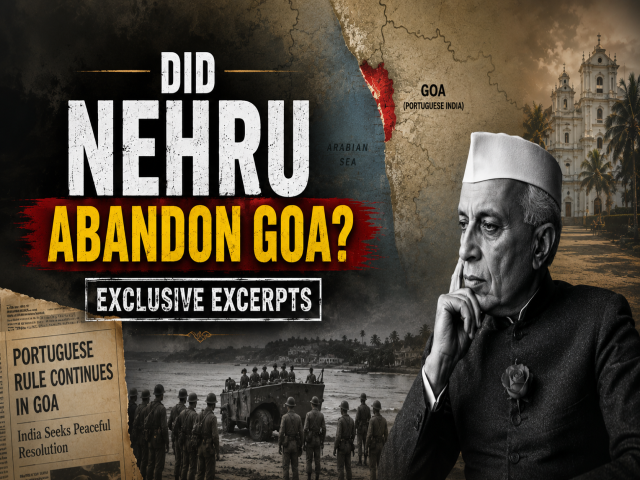
After the episode of 18th June, when Nehru, in a newspaper interview, said that Goa was a pimple on the face of India and would be part of India soon after independence, he did not intend to oppose Dr Lohia's action. But he sincerely felt that the action was unwarranted since the time had not come to raise the issue of Goa's independence. He did not visualise the intensity of the civil liberties issue, as Dr Lohia and Mahatma Gandhi did. While the Indian National Congress was surrounded by several problems, including the partition of India and the crucial issue of getting Kashmir under the Indian Union, Nehru did not want to be troubled with tackling the issue with another colonial regime, that too the fascist reign of the Portuguese. He also sincerely believed that the Portuguese and the French would leave the country once the most dominant power, the British, vanished from India.
However, when he was confronted with the issue as the mass upsurge after 18th June led to repression, terror, arrests and even deportations, Pandit Nehru did not lag in performing his duty as the responsible leader and future Prime Minister of India. His interview with the 'pimple statement' was published on 11th July. Linking it to Kashmir, where Nehru was arrested at the same time when the 18th June episode happened, Dr Lohia reacted sharply, stating that the pimple of Goa had disfigured the face of India more than the pimple of Kashmir. Eminent journalist Dattatray Venkatesh Pai wrote in his book that most of the Goan activists did not like the way Dr Lohia reacted 'negatively' to Nehru's statement.
Neither was Nehru averse to Goa's independence and its merger into the Indian Union, nor was he indifferent to the Satyagrahis of Goa. In fact, on the same day when his interview on the 'pimple statement' was published, he gave almost 15 minutes to Purushottam Kakodkar and Evagrio Jorge to know what was happening in Goa, that too, when he was elected the President of the INC, which was trying to find an amicable solution to the issue of Pakistan raised by Mohammad Ali Jinnah.
The 'pimple statement' made on 11th July was just a passing remark Nehru made in a lengthy newspaper interview on various issues confronting India's forthcoming independence at a very crucial juncture. But his exact position on Goa he revealed within a week, through a comprehensive press statement, issued from Delhi on 20th July. He not only spoke of different issues that had cropped up about Goa, but also publicly offered a hand of cooperation from the Indian National Conference:
"In the midst of formidable problems which face India, little Goa offers its own problem. But because Goa is an enclave on the west coast of India, we may not ignore or forget it... I should like to tell the people of Goa how we all sympathise with them in this struggle and how we are following it with anxious interest. For us, Goa is as much a part of India as any other part, and the freedom of India inevitably includes the freedom of the people of Goa. Goa cannot be separated from India. So any struggle for freedom there becomes part of our own struggle...
To the people of Goa, I send my greetings and good wishes."
The excuse to release this press statement was the arrest of Dr TB Cunha on 12th July, the day after his 'pimple statement' was published. Soon after, GYL President Joachim Dias and Beatriz Menezes de Braganza, daughter of Luis Menezes Braganza, rushed to Delhi to meet Nehru and apprised him of Dr Cunha's arrest and what else was going on in Goa.
"Eighteen years ago, a Congress committee was started in Goa by Mr Tristao Braganza Cunha, and for some years he was a member of the All India Congress Committee. Later, under the Constitution of the Congress, such foreign committees were not affiliated.
I remember those days of association with Mr Cunha. Now he lies in some Portuguese prison, waiting to be tried by court-martial, although no martial law has been proclaimed in Goa and Mr Cunha is not a soldier...
… The trial by court-martial of a well-known citizen and public worker of Goa for his standing for civil liberties is something that is peculiarly bad. I understand that he was not even given sufficient time to prepare for his defence."
THE INTERNATIONAL AMBIT
Pandit Nehru was fully aware of the Anglo-Portuguese alliance, though Portugal had remained neutral during the war, but had secretly helped Great Britain. In March 1946, on the 22nd to be precise, during the post-war diplomatic visit by the British Admiral Edward Nevelle Syfret to Lisbon, at a dinner party, Syfret had toasted Dr Salazar in these words:
"Portugal and Britain are closely united by bonds of maritime tradition and strong alliance, which have remained steadfast and enduring for many centuries. The old alliance stands today firmer than ever before. It has proved the guiding light of our common history and a security to our lives and destinies."
In a spontaneous response to this imperialist call, Dr Salazar said:
“And the alliance is not only consecrated in age-long treaties, but it lives through the high ideals we hold in common, and has been sealed through ages, by land and sea, with the Portuguese and British blood that has so often been shed in common defence of these ideals... Our alliance stands... for a true political and moral institution, a traditional association of interests and of affection which remain strong and unique in the world- so strong that the alliance has held glorious and unbroken throughout the profoundest changes in history. The important part, which our countries have played in the history of Christian civilisation is not yet ended. It affords a lesson stimulating us to remain loyal to the same ideals, to serve the same cause, for the welfare of our peoples and in defence of the civilisation we have helped to build."
Against this backdrop, Pandit Nehru was fully aware that freeing Goa or Pondicherry would not be a cakewalk but would require international diplomacy. Secondly, Portugal was under fascist rule, unlike Great Britain or France. What also prompted Nehru to issue a comprehensive statement on Goa was the interview of the Portuguese Minister for Colonies, Marcello Caetano, published on 17th July in a Lisbon-based daily and flashed throughout the world by the Portugal- based news agency 'Agência Noticiosa Lusitânia. The minister in this interview had stated that Goa was not a colony but the 'state' of Portugal. In response, Nehru retorted:
"Goa raises international issues, which are bound to come to the forefront in the near future... In Goa, for a vast span of years, there has been no shadow of civil liberty. No meetings can be held, and nothing can be printed, not even a wedding card, without police permission. For us, Goa is as much a part of India as any other part, and the freedom of India inevitably includes the freedom of the people of Goa. So any struggle for freedom there becomes part of our own struggle. But whatever struggle there may be, it is wholly unbecoming for the Portuguese authorities in Goa to use the methods they adopted.”
Exclusive excerpts from Sandesh Prabhudesai's latest book "64 Days Of 18 June 1946"