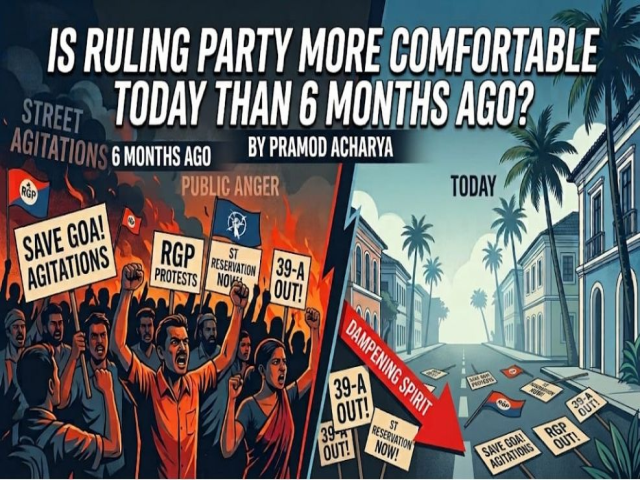
For the past few days, a topic that has been persistently debated across Goa is the impending approval of political reservation for Goa’s tribal community. Speculations and analyses are pouring in from all quarters: whose political future will flourish, whose will fade, where sitting MLAs will head if their constituencies are reserved, what people from the so-called General Category should do now, and whether the Bhandari community should also demand reservation. All these issues have surfaced merely because of the notification on tribal reservation.
Unfortunately, except on platforms run by UTAA (United Tribal Associations Alliance) and the tribal community itself, hardly anyone has been addressing why reservation in political power is necessary, what its underlying rationale is, or the paramount importance of reservation in the broader process of social justice. It is deeply concerning that the discourse around tribal reservation has not moved beyond weighing personal and party gains or losses and examining how other communities perceive it.
In post-independence India, the question of caste has largely been reduced to reservations. Caste, however, is a pervasive reality, and if it is to be eradicated, adopting a steady, democratic process is essential. Today, political reservation is merely viewed as a transient “electoral formula” for power-sharing or a “vote-bank convenience.” Representation in the legislature does not simply mean an individual from a particular caste occupying an MLA’s seat; it signifies that a group intentionally kept away from decision-making processes for centuries gains a direct and decisive stake in state policymaking and the distribution of wealth.
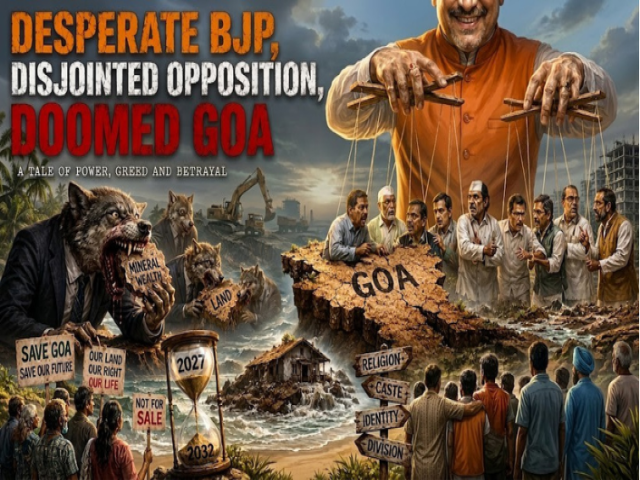
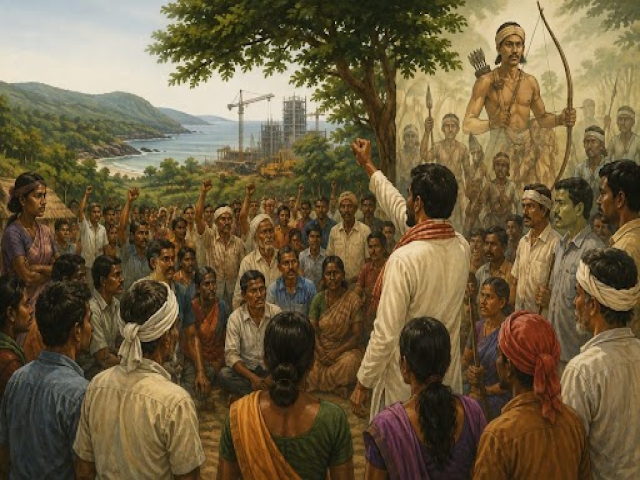
Looking at the specific context of Goa, the struggle of the tribal community is not limited merely to constitutional rights. It is intertwined with their indigenous habitation on forest and land — jal, jungle, zameen — and the preservation of their cultural identity. Goa is witnessing rapid, unrestrained development, land transfers and the plunder of natural resources, the brunt of which is borne most heavily by the indigenous community. The lack of an autonomous voice for them in the legislature was a major democratic void. Political reservation is a constitutional pathway to redress that historical injustice.
As long as we do not abandon the narrow mindset of viewing reservation merely as a system that “robs opportunities” from other communities, the true objectives of social justice will remain unfulfilled. The urgent need of the hour is that the political upheaval sparked by tribal reservation should not remain confined to whose calculations succeeded or failed. Rather, it must direct society’s focus towards fundamental issues — the empowerment of marginalised sections in Goa and their democratic rights over resources.
Against this backdrop, the speech delivered by Priol MLA Govind Gaude at the Mardol public meeting is immensely significant. There is no doubt that Gaude’s speeches are fiery and impassioned. However, reducing his recent address solely to tribal reservation would be incorrect. Alongside the concerns of the tribal community, Gaude’s speech sharply reflected deep concern for the political future of the entire working class. Invoking the Constitution framed by Dr Babasaheb Ambedkar on one hand, and the tradition of Bahujan politics in Goa represented by Bhausaheb Bandodkar, Shashikalatai Kakodkar, Ravi Naik and Vishnu Surya Wagh on the other, Gaude bridged these two streams.
Earlier, while writing about Ravi Naik, I had noted that as long as Ravi Naik remained active in politics, he kept alive the possibility of an autonomous Bahujan-centric politics. Gaude has breathed fresh life into that very possibility through his speech. If the Bahujan community in Goa is concerned about its political future, it must recognise these possibilities and chart its future course accordingly.
The BJP, too, has its own stance regarding tribals and an entire programme designed around the community. It operates on a dual agenda: deploying the symbol of Birsa Munda across the country to garner tribal votes, while simultaneously handing over lands under tribal jurisdiction to capitalists like Adani and Ambani. In contrast, Govind Gaude’s speech and the overall tone of UTAA’s convention connected local tribal issues to the broader and autonomous Bahujan political tradition of this land. They did not borrow the standardised tropes of tribal politics prescribed by the BJP.
The answer lies in the mechanics of a ruling apparatus that thrives on atomising subordinate groups into competing electoral factions. Historically, the strength of Goa’s Bahujan movement lay in its capacity to construct a broad, cross-caste coalition bound by shared agrarian struggles and a common demand for socio-political dignity. When that collective consciousness is fractured into isolated, transactional caste lobbies, dominant interests can comfortably co-opt individual community leaders while steadily divesting the broader working class of its land, resources and institutional power.
By demonstrating that collective resolve can extract major policy concessions from an otherwise indifferent state machinery, the tribal mobilisation offers a blueprint that other marginalised communities cannot afford to ignore. If groups like the Bhandaris, pastoralists and other traditional occupational communities continue to allow their political agency to be brokered by intermediaries rather than forged through mutual solidarity, they will remain perpetual spectators in the corridors of power.
The real task ahead, therefore, is not merely to celebrate this administrative milestone, but to transform this breakthrough into sustained inter-community dialogue. True democratisation will not arrive through periodic handouts or calculated electoral sops, but through an autonomous, united Bahujan front capable of setting its own terms for Goa’s future.
Kaustubh Naik is a PhD candidate at the University of Pennsylvania.