
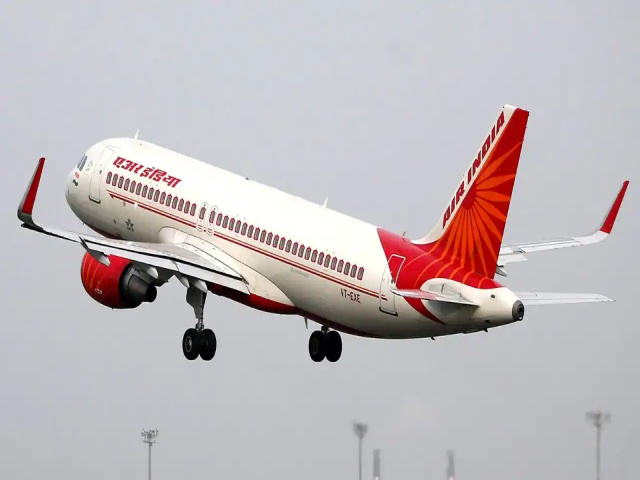
The Aircraft Accident Investigation Bureau (AAIB) has revealed that an Air India Airbus A320neo temporarily lost pressure in all three hydraulic systems while cruising at 36,000 feet during a Phuket-New Delhi flight on August 4, triggering an autopilot disconnect, stall warning and a major altitude upset that left 24 passengers and crew members injured.
According to the preliminary investigation report, Air India flight AI-2379 was carrying 137 passengers, including three infants, six cabin crew members and two cockpit crew when the incident occurred over Indian airspace.
The aircraft had been cleared by Kolkata Air Traffic Control to climb from Flight Level 340 to FL360. At 04:02:43 UTC, while cruising at FL360, the flight control system recorded a loss of the Green hydraulic system. Four seconds later, the Blue and Yellow hydraulic systems also registered a loss of pressure, temporarily affecting all three independent hydraulic circuits.
The hydraulic failure triggered multiple cockpit warnings and automatically disconnected the autopilot. A continuous repetitive chime sounded, followed seconds later by a two-second stall warning.
The First Officer, who was the Pilot Flying, intervened to stabilise the aircraft before the Captain took manual control. The hydraulic systems then began recovering, with the Blue system regaining pressure first, followed by the Yellow and Green systems.
The AAIB found that the aircraft experienced a significant altitude fluctuation during the approximately 10-second event. It climbed 372 feet above its assigned altitude before subsequently descending 292 feet below it.
Cabin Damage And Injuries
The altitude upset occurred while the aircraft was cruising in smooth conditions with the seatbelt signs switched off, causing unrestrained occupants to be thrown around the cabin.
The AAIB's examination found extensive interior damage, including cracked and deformed ceiling panels, damaged passenger service units, broken overhead handrails and dislodged overhead-bin doors.
Damage was also reported to a cabin crew swivel seat and headrest, ceiling panels near the rear doors and the floor mounting of a lavatory commode.
The cabin supervisor informed the cockpit about the injuries. After assessing the situation, the flight crew decided to continue to New Delhi instead of diverting to an alternate airport.
The crew requested priority handling and medical assistance from Delhi ATC. The aircraft landed safely on runway 11L at Delhi Airport at 05:30 UTC and taxied to its parking bay under its own power.
Emergency medical personnel treated 24 occupants — 20 passengers and four cabin crew members. The report states that 20 were treated for minor injuries and discharged, while four sustained serious injuries requiring continued hospitalisation.
Captain's Psycho-Active Substance Test
The AAIB report has also highlighted the results of mandatory post-flight medical examinations of the two pilots.
Both pilots tested negative for alcohol during breathalyser examinations. The First Officer also tested negative for psycho-active substances during both rapid screening and subsequent laboratory testing.
However, the Captain returned a non-negative result during the rapid psycho-active substance screening. The result was subsequently confirmed as non-negative through blood analysis at a pathological laboratory.
In view of the finding, the AAIB issued an urgent safety recommendation to the Directorate General of Civil Aviation (DGCA), advising it to take appropriate action to prevent the abuse of psycho-active substances.
Investigation Into Hydraulic Failure Underway
The AAIB has classified the occurrence as an accident and notified France's Bureau of Enquiry and Analysis for Civil Aviation Safety (BEA), representing the state of design and manufacture of the aircraft.
An Airbus technical team inspected the aircraft in Delhi between August 13 and 15 along with Indian investigators. Samples of hydraulic components and fluids, fuel and engine oil were collected for laboratory examination.
Investigators also downloaded data from the aircraft's Solid-State Flight Data Recorder and Cockpit Voice Recorder to reconstruct the aircraft's flight path, control inputs and hydraulic pressures during the incident.
The aircraft involved was an Airbus A320-251N manufactured in 2018 and leased from Alafco. It had been dispatched from Phuket under an authorised Minimum Equipment List provision for an inoperative Power Transfer Unit (PTU), which had been recorded on July 28.
Investigators are examining why all three independent hydraulic systems temporarily lost pressure and then recovered within seconds. The possible role of the inoperative PTU, along with other technical, operational and human factors, is also being assessed.
The AAIB has stressed that the findings are preliminary and that the investigation remains ongoing. A final report will be issued after the probe is completed.
AAIB Report Reveals Triple Hydraulic Failure And Altitude Upset On Air India Flight
Preliminary probe finds simultaneous loss of all three hydraulic systems at 36,000 feet; 24 injured and Captain's psycho-active substa
Latest in GENERAL
 NEW
NEW
GENERAL
Janmashtami Celebrated With Devotion Across Goa
Janmashtami, marking the birth of Lord Krishna, was celebrated with religious fervour and devotion across Goa

GENERAL
Goa Animal Federation Questions Government’s Dog-Bite Figures in Assembly
The Goa Animal Federation has challenged the accuracy of the dog-bite statistics recently presented in the State Legislative Assembly. Shwet