
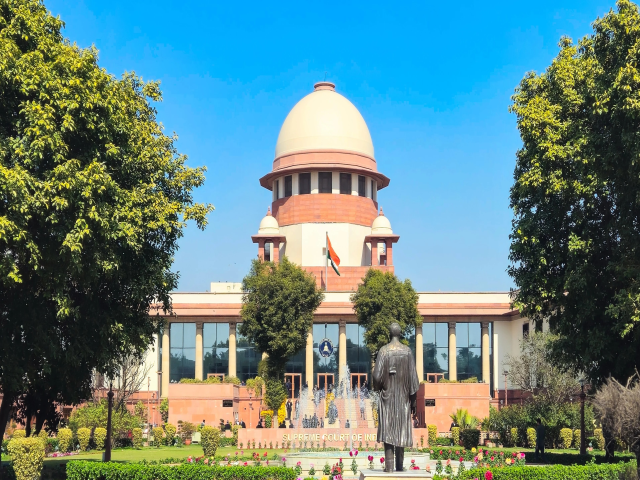
Ruling that the principle of parity cannot be applied mechanically when an accused played a distinct and central role in a crime, the Supreme Court has rejected the bail plea of Rajendra Prasad, who was chargesheeted by the Old Goa police as the prime accused in the murder of Chandrika alias Gabbar Sahani.
The Supreme Court upheld the Bombay High Court at Goa’s decision to deny bail, noting that Prasad was prima facie the “principal architect” of the premeditated killing.
According to the prosecution, the conspiracy and murder arose from an ongoing property and family dispute originating in Gorakhpur, Uttar Pradesh. On 23 August 2023, Rajendra Prasad allegedly lured the victim to his rented accommodation in Porvorim under the pretext of offering painting work. Prasad and co-accused Ranajit Prasad are said to have wrongfully confined the victim and assaulted him brutally with a wooden stick. Joined by two other associates, Akhilesh Kumar Sahani and Rajkumar Prasad, Rajendra Prasad allegedly tied the unconscious victim to a heavy stone using nylon rope and iron hooks, transported him by car, and threw him into the Gaundalim river.
Following an investigation by the Old Goa police, Prasad was arrested on 29 August 2023 and chargesheeted for murder, wrongful confinement, causing disappearance of evidence, and criminal conspiracy.
Prasad’s counsel argued he was entitled to bail on parity grounds because two co-accused had already been released on bail by the High Court. Counsel also pointed to alleged inconsistencies in the prosecution’s case and to Prasad’s prolonged incarceration of nearly three years, with only one out of 62 witnesses examined so far.
Counsel for the State of Goa opposed bail, emphasising that Prasad’s role was far more active and distinct than that of the co-accused, and warning of the risk of witness tampering.
Rejecting Prasad’s plea, the Supreme Court clarified that parity is not a mechanical rule and must be applied having regard to the specific role of each accused. The bench observed that while the co-accused acted as facilitators, Prasad’s role stood out. The court added that nearly three years of incarceration does not automatically entitle an accused to bail given the gravity of the offence and the risk of influencing witnesses.
To balance the petitioner’s right to a speedy trial with the need to protect witnesses, the apex court directed the trial court to make sincere efforts to record the testimony of eight crucial and vulnerable witnesses out of turn within one year.
The Supreme Court granted Prasad liberty to file a fresh bail application once those eight testimonies are recorded, or upon the expiry of the one-year period, provided he cooperates with the trial proceedings and does not cause delays.
Parity Is Not a 'Mechanical Formula': SC Denies Bail to Prime Accused in 2023 Old Goa Murder Case
Supreme Court has rejected the bail plea of Rajendra Prasad, who was chargesheeted by the Old Goa police as the prime accused in the murder
Latest in LEGAL
 NEW
NEW
LEGAL
Court Denies Bail to Accused in Brutal 2020 Bicholim Dismemberment Murder Case
North Goa Additional Sessions Court has rejected the second bail application of accused Sanjay Paswan in the September 2020 murder and disme

LEGAL
Goa Govt Agrees In Principle To Shift Shivaji Maharaj Statue From MPA Land
High Court Grants Time To Finalise Relocation Site; Matter Posted For August 25