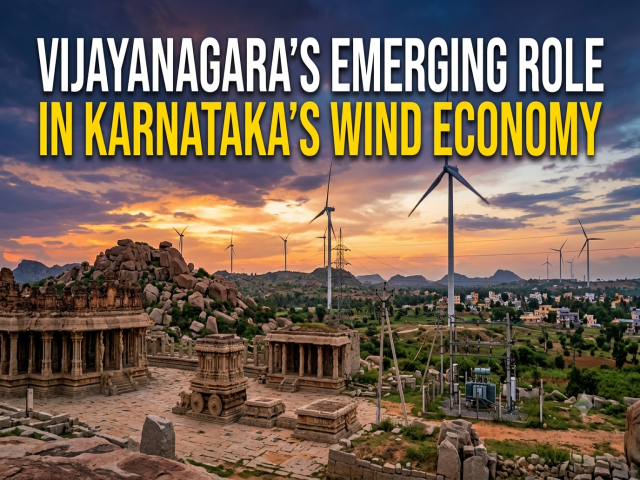
Vijayanagara is beginning to acquire a new identity in Karnataka's energy map. The district, better known for the ruins of Hampi, mining and agriculture, is increasingly becoming part of Karnataka’s renewable energy story. In particular, the wind corridors around Kudligi, Kotturu, Harapanahalli and other parts of the district are attracting wind and hybrid renewable energy projects.
This is not simply a story about turbines appearing on hilltops. It is about how a resource that was once largely invisible to the local economy is becoming an economic asset, while helping Karnataka strengthen its clean energy base.
The scale of Karnataka’s wind sector provides the larger context. As of June 2026, Karnataka had 8,896 MW of installed wind power capacity, making it the third-largest wind power state in India after Gujarat and Tamil Nadu. During 2025-26, Karnataka generated about 18,804 million units of electricity from wind. Vijayanagara is now positioning itself to contribute more significantly to this capacity.
A natural advantage
The first reason is geography. Parts of Vijayanagara have terrain and wind conditions suitable for utility-scale wind development. The latest district-level assessment by the Karnataka State Council for Science and Technology identified 219 wind turbine locations across several gram panchayats in Vijayanagara, including substantial concentrations in Kudligi and Harapanahalli.
This is significant because the wind industry is no longer driven merely by the availability of land. Developers look for a combination of wind resource, grid connectivity, road access, land availability and the possibility of securing long-term power offtake. Vijayanagara is increasingly able to offer this combination. The district also has an industrial base that can create local demand for renewable electricity. The presence of energy-intensive industries around Hosapete and Sandur makes the integration of renewable generation with industrial consumption particularly relevant.
The beginning of a larger investment cycle
The more interesting development is the pipeline of projects. Few wind project is being developed in different part of the district. Transmission infrastructure approved for the project is designed to evacuate substantially more power, with the associated 220 kV line capable of evacuating about 300.3 MW from the wind farm.
In 2025, the Central Transmission Utility also recorded proposals involving additional wind, solar and battery storage capacity in Kudligi. One proposal included an additional 100 MW of wind and 100 MW of battery energy storage without requiring additional grid connectivity. These developments point to something larger than individual wind farms. Vijayanagara could gradually become part of a renewable energy cluster in which wind, solar, storage and transmission infrastructure complement each other.
That is particularly important because wind and solar have different generation patterns. Solar generation peaks during the day, while wind production can be stronger at different hours and seasons. Combining them with battery storage can improve the reliability and usefulness of renewable power.
What does this mean for Vijayanagara?
For local communities, the benefits must go beyond the visual presence of turbines. The first benefit is income from land. Where private agricultural land is used for turbines, access roads or other project infrastructure, landowners can receive lease payments or other forms of compensation depending on the contractual arrangement. This can provide farmers with a supplementary and relatively predictable income while allowing them to retain ownership of their land in many project models.
The second opportunity is employment. Wind farms require workers for construction, electrical works, civil works, transportation, operations and maintenance. Not all jobs will be permanent, but the development of a renewable energy cluster can create sustained demand for technicians, electricians, welders, machine operators, drivers and other skilled workers.
This creates an important opportunity for local youth. Industrial training institutions and polytechnics in the region can align courses with renewable energy requirements, particularly electrical maintenance, mechanical systems, safety, instrumentation and basic turbine operations.
The third benefit is the possibility of developing a local services economy. Wind projects need accommodation, transport, equipment maintenance, security, civil contractors, food services and other support activities. If local entrepreneurs are integrated into these supply chains, renewable energy can generate economic activity well beyond the project boundary.
Why Karnataka should care
For Karnataka, the significance is strategic. The state is already one of India's major wind power producers. Expanding wind generation in districts such as Vijayanagara can diversify the state's renewable energy geography and reduce pressure on a limited number of established renewable energy zones.
It can also help Karnataka meet its growing electricity demand without increasing dependence on fossil-fuel-based generation. Renewable power is increasingly important not only for conventional electricity supply but also for industries seeking lower-carbon energy for their operations.
There is another advantage. Vijayanagara's renewable energy development can help connect the economic transformation of North Karnataka with the state's clean-energy transition. Historically, much of Karnataka's high-value investment has been concentrated around Bengaluru and a few major industrial centres. Renewable energy offers districts with strong natural resources a chance to attract capital and infrastructure. But this opportunity must be managed carefully.
Development must include the people
The real test will not be the number of turbines installed. It will be whether local communities see renewable energy as an economic opportunity rather than simply another infrastructure project occupying rural landscapes. Land agreements must be transparent. Payments must be timely and clearly explained. Local employment should be prioritised wherever skills are available. Companies should invest in training local youth rather than relying entirely on workers brought from outside the district.
Equally important is environmental planning. Wind projects must avoid sensitive ecological areas and minimise impacts on agriculture, wildlife and local water resources. Transmission corridors should be planned with equal care.
Vijayanagara therefore has an opportunity to create a model for responsible renewable development: private investment supported by strong public infrastructure, local participation and environmental safeguards. The wind sweeping across the dry landscapes of Vijayanagara is not new. What is changing is our ability to convert that natural resource into economic value.
If planned well, the district can move from being merely a host for wind turbines to becoming a genuine renewable energy hub, creating income and skills for its people while helping Karnataka build a cleaner, more resilient and more competitive power system.
That is why Vijayanagara's emerging wind economy deserves attention. The real story is not about turbines on the horizon. It is about whether the wind can become a new source of prosperity for the people who live beneath them.