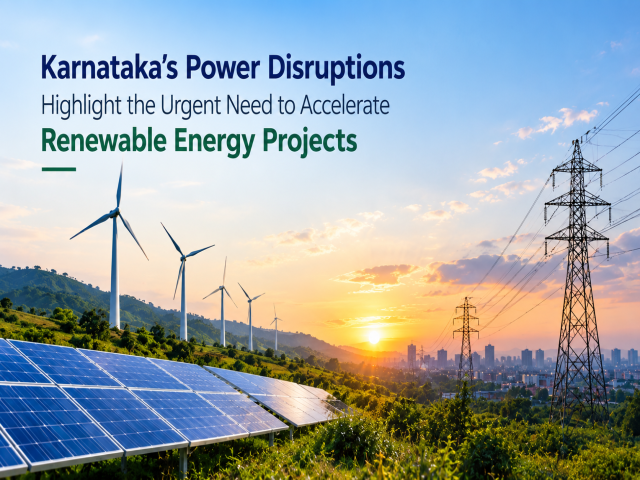
Karnataka has long been regarded as one of India's leading renewable energy states. Its solar parks, wind farms and growing clean energy capacity have placed it at the forefront of the country's energy transition. Yet recent disruptions in electricity supply have exposed an uncomfortable reality: having a large renewable energy base does not automatically guarantee reliable electricity when consumers need it most.
The power disruptions reported in September 2026, following a sharp fall in wind generation in parts of southern Karnataka, underline the need for a more urgent and coordinated approach to renewable energy development. The answer is not to move away from clean energy. It is to accelerate renewable projects while building the storage, transmission and grid management systems required to make them dependable.
Demand is rising, but reliability remains a challenge
Karnataka's electricity requirements are being reshaped by industrial expansion, urbanisation, electric mobility, data centres and the increasing use of electricity in agriculture and commercial activity. Bengaluru's technology economy alone creates a strong need for uninterrupted and high-quality power. At the same time, manufacturing investments across the state are increasing the importance of a stable electricity supply. The state has recognised this challenge. Its reported plan to increase installed power capacity from more than 39 GW to approximately 66 GW by 2030 reflects expectations of sustained demand growth and significant investment in renewable generation, storage and supporting infrastructure. The proposed expansion is also intended to attract substantial private investment into Karnataka's energy sector.
However, capacity on paper and electricity available at a particular moment are two different things. A solar plant cannot produce electricity after sunset. Wind generation can change considerably within a few hours. Hydropower depends on reservoir levels and rainfall. Thermal power, meanwhile, faces fuel, maintenance and operating constraints.
This distinction is central to understanding Karnataka's recent difficulties. The state may have substantial generating capacity, but the available supply can become tight when several factors move in the wrong direction at the same time.
The warning from falling wind generation
The reported decline of approximately 2,000 MW in wind generation on September 9, 2026, affected power availability in parts of southern Karnataka. Such an event demonstrates how quickly a system can come under pressure when renewable output falls during a period of high demand. Wind energy remains a major advantage for Karnataka. The state has extensive wind resources, particularly across its central and northern districts. But wind projects must be planned as part of a wider electricity system rather than treated as isolated generating assets.
In December 2025, the Union government identified land conversion and grid evacuation as major challenges for wind projects in Karnataka. The state had approved measures to simplify the conversion process, but effective implementation remains important. Still, securing suitable land remains one of the most persistent challenges for wind developers in Karnataka. Wind projects require land not only for turbine foundations, but also for access roads, internal electrical networks, substations and other associated infrastructure. On the ground, developers often face delays due to concerns and objections from landowners, farmers and local stakeholders, as well as difficulties in securing timely local cooperation. These challenges can slow project execution, increase costs and create uncertainty around project timelines.
Renewable projects must move from announcements to execution
Karnataka has considerable renewable energy potential, but the pace of project execution must match the urgency of electricity demand. The state needs to focus not only on announcing new projects but also on ensuring that projects reach commercial operation on time.
Land-related challenges, environmental permissions, financing difficulties, equipment supply, evacuation constraints and delays in connecting projects to the grid can all slow progress. According to data reported in June 2026, 386 of 519 allotted small hydro projects in Karnataka had been cancelled or had failed to reach commissioning, with environmental and other clearances among the major difficulties.
Every stalled project represents more than a missed investment opportunity. It also means that the expected electricity is not available to consumers, industries and the wider economy.
The state should therefore establish clear project milestones, strengthen coordination among departments, simplify approval processes without weakening environmental safeguards and identify projects that can be commissioned quickly. Developers who demonstrate the ability to execute should be supported, while projects that remain inactive for years need timely review.
A reliable clean energy future is achievable
Karnataka's recent power disruptions should be treated as a warning, not as a reason to slow the renewable energy transition. They show that clean electricity generation must be accompanied by careful planning, timely execution and investment in the complete power system.
The state has the natural resources, industrial base and technical capabilities to build a strong renewable energy economy. It can attract investment, create employment, support farmers through responsible land-use arrangements and provide more affordable electricity to its growing industries. But these benefits will be realised only when projects are completed and their electricity can reach consumers when required.
The priority now should be a coordinated programme that accelerates solar and wind projects, strengthens hydropower resilience, develops battery and pumped storage, expands transmission capacity and improves distribution reliability.
Karnataka's energy future should not be defined by the question of whether renewable energy can generate enough electricity. It should be defined by whether the state can deliver that electricity reliably, affordably and sustainably.
The opportunity is substantial, but the time for fragmented planning has passed. Karnataka must move from renewable energy ambition to dependable renewable energy delivery.