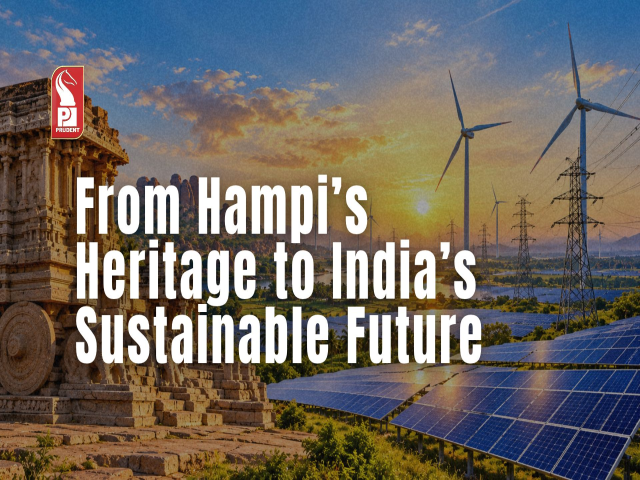
The stone monuments of Hampi stand as a reminder of a time when the Vijayanagara Empire demonstrated remarkable ambition in architecture, commerce and water management. Its historic tanks, reservoirs and irrigation systems reflected an understanding that prosperity depended not only on wealth and trade, but also on the careful management of natural resources. Centuries later, that legacy carries a contemporary message for Vijayanagara district: development must create prosperity while protecting the resources and communities that sustain it.
Today, India faces the challenge of meeting rising electricity demand while reducing its dependence on fossil fuels. Wind energy offers an important part of the answer. For Vijayanagara, a district known for its cultural significance and rural economy, the emerging clean energy transition presents an opportunity to look beyond its historical identity and consider how responsible development can contribute to a sustainable future.
Wind power generates electricity by using the movement of air to turn turbine blades, which drive a generator. Unlike coal-based power generation, it does not require continuous fuel combustion during operation. Wind energy can therefore help reduce power-sector emissions, diversify electricity supplies and strengthen India's long-term energy security. It also complements solar power, particularly when wind and sunlight are available at different times.
For a country seeking to expand clean electricity while supporting industrial growth, agriculture and urbanisation, this diversification matters. Karnataka has an important role in India's renewable energy transition. However, the benefits for Vijayanagara should not be assumed simply because the district is part of a state pursuing cleaner energy. They will depend on suitable sites, reliable infrastructure, responsible planning and the extent to which local communities participate in the development process.
Farmers must remain at the centre
For rural communities, the most immediate question is not how many turbines can be installed, but what energy development means for those whose land and livelihoods may be affected.
Where project arrangements permit, landowners may receive lease payments for hosting wind turbines or associated infrastructure. Local businesses may find opportunities in transportation, equipment handling, civil works and other support services. Maintenance activities can also create demand for trained workers. The scale and distribution of these benefits, however, will vary according to project design, contractual terms, local conditions and implementation.
These possibilities must be accompanied by safeguards. Farmers need clear information about land requirements, lease periods, payment schedules, access routes and the implications of agreements for future land use. Compensation, where applicable, should be determined fairly and paid on time. Agreements must respect landowners' rights, while construction and maintenance arrangements should minimise unnecessary disruption to cultivation, irrigation and movement across agricultural land.
Turning energy development into local opportunity
A sustainable energy transition should also create pathways for young people. Rural youth in Vijayanagara need opportunities to acquire skills that connect them with emerging industries without necessarily having to migrate far from home.
Wind energy projects may generate demand for workers in electrical systems, mechanical maintenance, safety procedures, equipment handling, logistics and site support. Not every role requires an engineering degree, but many require specific training, practical experience and adherence to safety standards. Partnerships with vocational institutions and skill development organisations could help prepare local candidates for suitable opportunities.
Local entrepreneurship deserves similar attention. Small businesses may be able to provide transport, accommodation, fabrication, repair services or other project-related support where procurement policies and technical requirements allow. Making local suppliers aware of opportunities and helping them meet required standards can widen participation in the economic activity associated with energy infrastructure.
Community development, meanwhile, should be shaped by actual local needs rather than a standard list of activities. In consultation with residents, responsible developers may support initiatives relating to education, healthcare, drinking water, agricultural productivity or livelihood development. Such initiatives should complement, not replace, the responsibilities of public institutions. Their value lies in addressing identified gaps and producing tangible benefits that communities can recognise.
Progress must respect people and place
None of these opportunities should obscure the challenges associated with infrastructure development. Wind projects require careful site selection, transmission connections and land arrangements. Construction can affect access routes, agricultural activity and local ecology. Turbines and associated infrastructure may also raise concerns about noise, visual impact, biodiversity and the protection of culturally significant landscapes.
In a district whose identity is closely associated with Hampi, sensitivity towards heritage and the surrounding environment is especially important. Development decisions must comply with applicable regulatory requirements and environmental safeguards. Where relevant, assessments should consider wildlife movement, drainage, water resources and the cumulative effects of infrastructure. Sites and routes must be selected with due regard for protected areas and cultural heritage.
Equally important is meaningful consultation. Residents should be able to understand proposed developments, seek clarification and express objections without feeling excluded from decisions affecting their surroundings. A transparent grievance redressal mechanism, with clear responsibilities and reasonable timelines, can help resolve concerns before they deepen into conflict.
The measure of responsible development is not the absence of disagreement. It is whether concerns are heard, rights are respected and decisions are taken through fair and accountable processes.
A future worthy of Hampi's legacy
Vijayanagara's heritage offers more than a reason to look back with pride. It provides an enduring reminder that prosperity is built through vision, practical ingenuity and an understanding of the relationship between people and natural resources.
Wind energy can become part of the district's development story, but its success must be judged by more than electricity generated or infrastructure installed. It should also be assessed through the confidence of farmers, the fairness of land arrangements, the skills acquired by young people, the opportunities available to local enterprises and the protection of the environment.
For Vijayanagara, the ambition should be clear: to preserve the legacy that makes the district distinctive while creating new opportunities for the generations who call it home. If clean energy development advances alongside community welfare, agricultural livelihoods and environmental responsibility, the district can contribute meaningfully to India's sustainable future.
Hampi's enduring achievement was not simply the scale of its monuments, but the vision of a thriving civilisation. Carrying that spirit forward means ensuring that progress reaches beyond power infrastructure and into people's lives. That is how Vijayanagara can honour its past while building a future worthy of its name.