
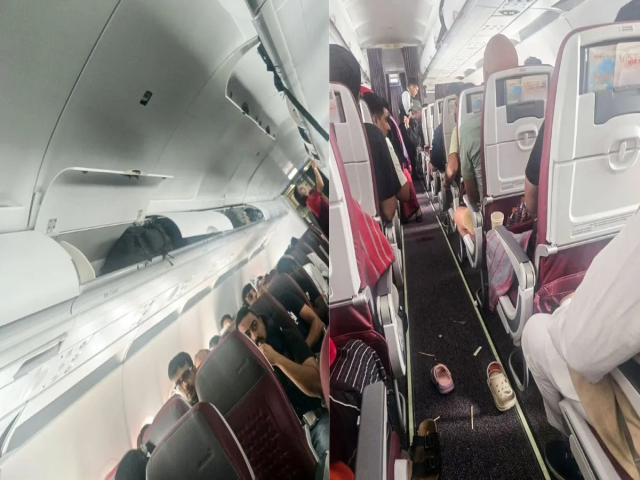
Airbus has issued a preliminary technical assessment following an incident involving an Air India A320 that suddenly lost around 300 feet of altitude before recovering during a flight on August 4, 2026.
According to the Airbus Customer Services document, the aircraft involved was A320 MSN 08470, operating Air India flight 2379 from VTSP/HKT to VIDP/DEL. The incident resulted in injuries on board and prompted Airbus to analyse the aircraft's flight data recorder information and reported technical faults.
Airbus said its analysis indicated that a loss of hydraulic pressure affected the aircraft's flight-control systems. Around 04:02:45, the B and Y hydraulic systems were lost, resulting in the temporary loss of both left and right elevator surfaces, the aileron surfaces and the remaining spoilers.
The document states that the elevators and ailerons were unavailable for approximately four seconds. During this period, the right elevator shifted to +0.6 degrees while the left elevator moved to -1.0 degrees. The ailerons subsequently deflected towards negative values, contributing to an increase in the aircraft's pitch.
The autopilot disconnected shortly afterwards, following which a full nose-down pitch input was applied. Airbus said the B hydraulic system recovered at around 04:02:51, followed a few seconds later by recovery of the Y and G hydraulic systems, allowing the flight-control surfaces to return.
Airbus also noted that its analysis identified an issue involving the G hydraulic pressure switch 1151GN. The manufacturer has asked Air India to carry out a series of operational tests on the green, yellow and blue hydraulic systems, along with checks of pressure switches, pressure transducers and associated indication systems.
The airline has also been asked to remove and identify pressure transducers and leak-measurement switches installed on the aircraft, with Airbus indicating that additional wiring checks may be required.
Separately, Airbus requested details of recent maintenance work carried out on the hydraulic system, as well as specific flight-control and automatic flight-system data corresponding to the time of the incident.
Because load exceedances were detected during the sudden altitude change, Airbus has called for inspections under the applicable maintenance procedures. It has also sought more detailed reports from the pilots to establish exactly what was observed during the event.
Airbus cautioned that the incident requires a detailed assessment covering both aircraft systems and structural integrity, as the airframe may have been affected by the sudden movement. The manufacturer said additional inspections could be required depending on the findings and that the final resolution could take longer than a standard aircraft-on-ground case.
Airbus Flags Hydraulic System Issues After Air India Flight Lost 300 Feet
Preliminary assessment links the sudden altitude drop to a temporary loss of flight-control surfaces, with further inspections and tests ord
Latest in GENERAL
 NEW
NEW
GENERAL
Student Drowning Case: DoE Issues Show-Cause Notice to School
Directorate of Education has issued a show-cause notice to Deepvihar School in Vasco and sought an explanation from the school management

GENERAL
55-Year-Old Man Swept Away By Strong Current In Sacorda River, Body Recovered
Krishna Mapari had entered the Ragada river to swim and cross it during a day outing with friends; search operation was launched after he we