
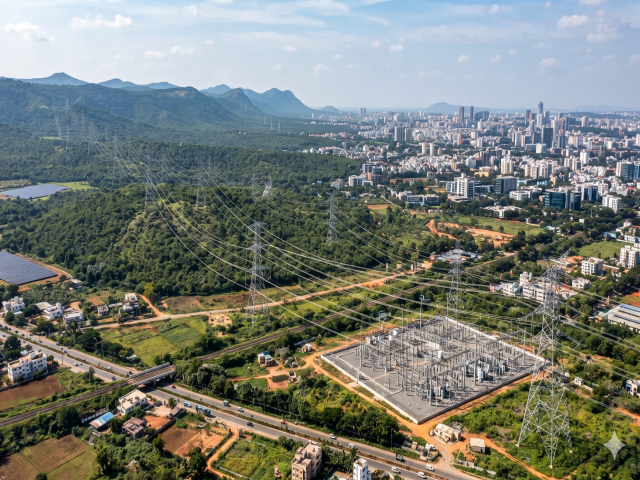
Karnataka's rise as one of India's most diversified state economies — anchored by information technology, precision manufacturing, biotechnology, and increasingly, renewable energy — rests on a foundation that rarely draws public attention: its power transmission network. While policy debates tend to fixate on generation capacity, it is the invisible web of high-voltage towers, substations, and transformers crisscrossing the state that determines whether electricity actually reaches a factory floor in Peenya, a data centre in Electronics City, or an irrigation pump in Kalaburagi. Transmission is the quiet infrastructure that makes every other economic ambition possible.
The backbone beneath the boom
Karnataka has emerged as a national leader in renewable energy, with wind and solar installations concentrated in districts such as Chitradurga, Tumakuru, Koppal, and Bagalkot. This geographic mismatch — generation in the north and centre, demand concentrated around Bengaluru and other industrial clusters — makes transmission infrastructure the critical link, not an afterthought. Without adequate intra-state transmission corridors and inter-state connectivity to the wider southern grid, renewable capacity remains stranded potential rather than usable power. The Karnataka Power Transmission Corporation Limited (KPTCL) has, over the past decade, expanded its network of extra-high-voltage lines and substations precisely to solve this problem, enabling the state to absorb variable renewable output without destabilising the grid.
Enabling industrial competitiveness
For manufacturers, reliability matters as much as tariff. A single voltage fluctuation can damage sensitive equipment in electronics assembly or pharmaceutical production; an unplanned outage can halt a semiconductor cleanroom or an automotive paint shop for hours. Karnataka's push to attract high-value manufacturing under initiatives like the state's electronics and aerospace policies depends on investors' confidence that power will be both available and stable. Robust transmission — with adequate redundancy and looped feeder arrangements — is what converts a promised industrial corridor on paper into a functioning one on the ground. Global and domestic companies evaluating where to locate a plant routinely treat grid reliability as a make-or-break criterion, on par with land acquisition and labour availability.
The digital economy's hidden dependency
Bengaluru's technology sector is often imagined as weightless — code, cloud, and capital — but it is among the most power-intensive urban economies in the country once data centres are counted. Data centres require not just continuous supply but power quality within tight tolerances, since even brief interruptions can corrupt transactions or trigger costly downtime for global clients. As Karnataka positions itself as a data centre hub for South Asia, transmission capacity in and around Bengaluru, Devanahalli, and the emerging corridors along NH-44 will determine whether that ambition is realistic or aspirational.
Rural and agricultural stakes
Transmission infrastructure is equally consequential away from the cities. Reliable feeder lines determine whether farmers receive adequate hours of quality power for irrigation pump sets, whether agro-processing units in tier-2 towns can operate cold storage without spoilage losses, and whether rural electrification translates into genuine economic opportunity rather than a nominal connection. The economic multiplier of transmission investment in districts like Ballari or Raichur is measured not merely in megawatts delivered but in reduced crop losses, longer working hours for small enterprises, and improved health outcomes tied to functioning cold chains for vaccines and food.
The investment imperative
Karnataka's transmission network needs sustained capital investment, not sporadic upgrades. This means expanding high-capacity corridors ahead of demand rather than in response to it, integrating smart grid technologies for better load management, and coordinating closely with the Central Transmission Utility on inter-state links.
As Karnataka competes with other states for the next wave of industrial and technology investment, its transmission grid deserves the same strategic attention as its ports, highways, and digital infrastructure. An economy cannot outrun the wires that power it.

