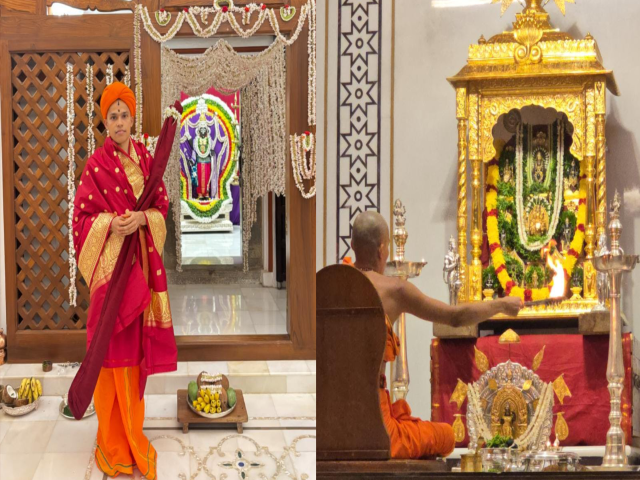
The 127th edition of the iconic Shree Damodar Bhajani Saptah, one of Vasco’s oldest and most revered festivals, commenced on Tuesday afternoon with the traditional installation of the ‘Srifal’ (coconut) at the feet of Lord Damodar at the Shree Damodar Temple by Prashant Joshi, amidst the devotional chant of “Bola Pundalika Varadhe Hari Vitthal.”
This year’s Saptah began on a grand scale, but with special caution for crowd control, especially during the main rituals. Police personnel were heavily deployed and access restrictions were implemented inside the temple to prevent any overcrowding. Devotees were seen lining up in long queues outside the temple, waiting to offer prayers once the rituals concluded.
speaking to media, Prashant Joshi of the Joshi family said, “The people of Vasco have been waiting for this festival for a long time and the 127th Saptah has finally begun. We have taken extra efforts to manage the crowd and ensure everyone’s safety. In view of past incidents like the stampede at the Lairai Jatra, we decided to impose access restrictions during peak rituals.”
Joshi added that inspections were conducted by government agencies and officials at the Collector level in the lead-up to the festival. “Officials from various government departments fearing and considering the possibility of a mad rush, recommended precautionary measures. This is the second time, the temple and surrounding fair area have been insured.”
As per tradition, the Srifal was placed by the Joshi family in the presence of devotees and members of the Damodar Bhajani Saptah Samiti. Among the politicians present in the temple during the main rituals were Vasco MLA Krishna Salkar, Mormugao MLA Sankalp Amonkar, MMC Chairperson Girish Borker, and representatives of various Paar groups who came to offer the ceremonial Thali. Also visiting the temple later in the day were Panchayat Minister Mauvin Godinho and other politicians.
The rituals were live-streamed on local platforms and social media, allowing devotees unable to attend in person to witness the auspicious ceremonies. While the temple saw a heavy rush, many devotees stood patiently outside to seek blessings.
The temple premises were decked in festive decorations, and the first round of bhajans began shortly after the Srifal installation, marking the beginning of the traditional 24-hour nonstop bhajan that defines the Saptah.
“The entire city is illuminated, and we expect the glorious Paar (mythological floats) to start arriving at the temple premises soon,” said Joshi. “We have hundreds of karyakartas who’ve worked tirelessly—from arranging barricades and managing crowds to setting up the stage and raising donations—for the smooth conduct of the 126th Saptah.”
Extending greetings to devotees, he said, “We pray that the rains don’t play spoilsport and that every devotee gets an opportunity to seek blessings of Lord Damodar.”
The Saptah will conclude on Wednesday afternoon with the immersion of the holy Srifal, installed during last year’s Saptah, into the sea at Kharewado by members of the Narvekar family. While the Saptah concludes on Wednesday, several stalls will continue to operate for the next seven days as part of the Saptah fair, drawing crowds from across the state.
The origins of the festival date back to 1899, during a plague epidemic in Vasco. With inadequate medical facilities at the time, locals turned to divine intervention. A coconut was brought from the Zambaulim temple and installed at Vasco in prayer. The plague was said to have miraculously ended thereafter, giving rise to the annual celebration of faith and devotion that continues to this day on the sixth day of the Shravan month.