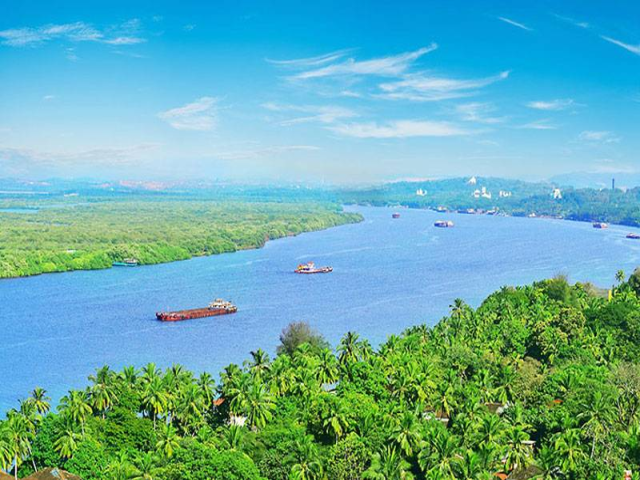
An interim environmental study of the Mandovi River has found that 100% of water samples tested during the 2026 monsoon season exceeded safe microbial limits for faecal coliform bacteria.
However, the report indicates that offshore casinos are not responsible for the contamination; instead, domestic drains and urban nullahs—most notably the heavily polluted St Inez Creek—are discharging untreated sewage into the river.
The interim findings were submitted by the Goa State Pollution Control Board (GSPCB) pursuant to directives from the High Court. The court had earlier raised concerns over alarming bacteriological contamination in the river stretch between the Mandovi bridges and the IFFI Jetty, an area where offshore casino vessels and marine tourism crafts operate.
The water-sampling exercise was conducted on August 24, 2026, at 22 designated locations across the Mandovi estuary, covering both high- and low-tide cycles. Of the 44 samples tested, every sample exceeded the Central Pollution Control Board limit of 100 MPN/100 ml for faecal coliforms. Faecal coliform counts ranged from 130 to 540 MPN/100 ml during high tide and spiked to between 130 and 940 MPN/100 ml during low tide.
The highest contamination level—940 MPN/100 ml—was recorded downstream of the anchored casinos, near the river mouth and along the Panaji shoreline. Elevated counts were also recorded upstream of the Mandovi Bridge and near the Cruise Boats Jetty.
By contrast, during the June 2026 pre-monsoon sampling, 16 of 36 samples met the permissible limit during high tide. The Board noted that a weaker monsoon during June, July, and August 2026 reduced seaward flushing, allowing microbial loads from terrestrial runoff to concentrate in the estuary.
While bacteriological indicators raised red flags, the estuary’s overall physico-chemical health remains robust. Dissolved oxygen levels ranged comfortably between 5.80 mg/L and 8.50 mg/L, exceeding the CPCB minimum baseline of 4.0 mg/L and indicating no oxygen stress for marine life. Biochemical oxygen demand remained below detection limits at nearly all sampling locations—well beneath the ceiling of 3.0 mg/L—except for a single reading of 2.1 mg/L recorded mid-stream near a casino vessel. Nitrates and nitrites also remained low, indicating no immediate risk of eutrophication or excessive nutrient loading.
Addressing the primary question raised by the High Court, the GSPCB confirmed that offshore casinos were compliant with wastewater-handling protocols. The Board stated that regular inspections and verified logbooks demonstrate that sewage and wastewater generated aboard the vessels are pumped directly into specialised sewage barges and transported to the Sewage Treatment Plant (STP) at Patto in Panaji; payment records have also been verified.
Instead, field inspections pointed to land-based, non-point sources of pollution. St Inez Creek was identified as the single most critical source of untreated effluent. A massive flow of 10,000 to 15,000 litres per minute of dark, foul-smelling, organic-laden discharge was observed pouring into the Mandovi near the Yoga Bridge, visibly discolouring an approximately 70-metre stretch of the river. Tidal currents subsequently push this effluent both upstream, past the Mandovi bridges, and downstream.
Rua de Ourem Creek discharges more than 20,000 litres per minute at the old Patto Bridge, carrying an estimated 10% to 15% untreated domestic sewage. The storm-drain canal at Penha de França was found discharging approximately 100 litres per minute of mixed domestic wastewater and stormwater laden with discarded plastic waste.
The GSPCB clarified that the report represents an interim assessment and forms part of an overarching three-season study mandated by the judiciary. The final phase—post-monsoon sampling across the 22 locations—is scheduled for late October and November 2026, with a comprehensive technical evaluation due before the High Court in December 2026.