
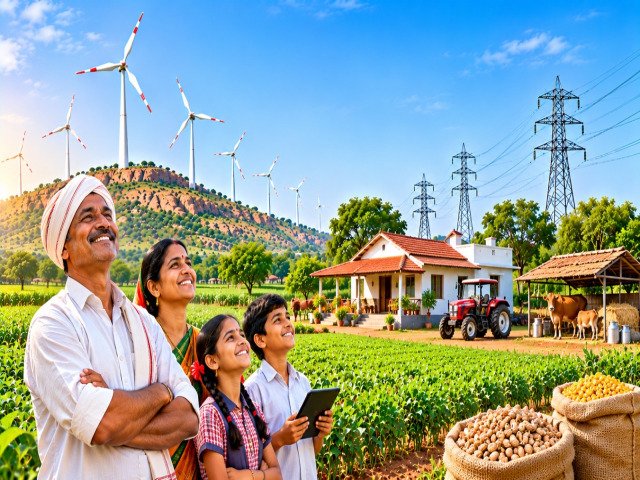
Vijayanagara district, celebrated globally for its storied heritage and industrial dynamism, stands on the cusp of an economic transformation. As Karnataka accelerates its clean energy transition, generating over 18,800 million units of wind electricity annually, our district’s natural geography has emerged as a vital asset. With robust wind corridors sweeping across ridges and open plains, Vijayanagara is uniquely positioned to become a regional powerhouse of clean energy, industrial synergy, and rural wealth creation.
Assessments by the Karnataka State Council for Science and Technology have already identified over 200 viable wind turbine locations across gram panchayats in the district, with prime concentrations in taluks such as Kudligi and Harapanahalli. This geographic advantage aligns seamlessly with the region’s economic geography. Nearby industrial centers in Hosapete and Sandur have high energy demands that can be decarbonized through localized renewable power. Furthermore, planned power evacuation lines, such as 220 kV transmission systems capable of handling over 300 MW, alongside proposed blade manufacturing facilities, signal that wind development will stimulate a broader manufacturing and service ecosystem.
Crucially, the success of this transition rests on establishing local farmers as true partners in progress. In agrarian heartlands, concerns naturally arise over land loss, environmental degradation, and crop disruption. However, wind energy operates under a fundamentally cooperative model. A wind turbine occupies only a fraction of an acre for its base and access path, meaning the vast majority of the land parcel remains undisturbed. Rather than losing their ancestral property, farmers retain complete land ownership and enter long-term lease agreements. In return, landowners receive a dependable annual income, providing an essential financial hedge against unseasonal rainfall, drought, and market volatility while allowing farming to continue unhindered right up to the turbine footprint.
Addressing local community concerns requires strict commitment to ethical, transparent execution. Project developers and authorities must ensure upfront consultations, transparent lease contracts registered with fair escalation clauses, and timely statutory clearances from local gram panchayats. Utilizing modern high-capacity turbines minimizes ground disturbance, while improved rural access roads built for equipment transport create lasting logistics benefits for nearby villages.
Beyond land revenue, wind energy can unlock tangible local opportunities for the next generation. The construction, grid integration, civil contracting, and ongoing maintenance of wind assets require skilled hands. By aligning local Industrial Training Institutes (ITIs) and polytechnics with renewable energy curricula, focusing on mechanical maintenance, electrical safety, and turbine operations, Vijayanagara’s youth can secure well-paying green jobs close to home.
By championing responsible development and positioning the farming community as respected stakeholders, Vijayanagara can protect its agricultural roots while securing a prosperous, clean, and self-reliant economic future.

