
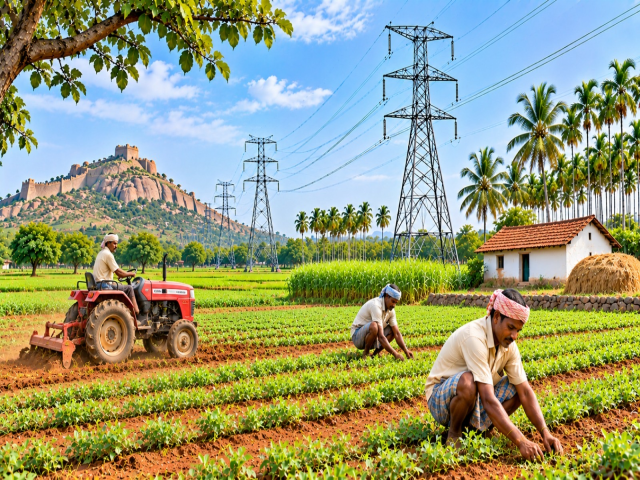
Agriculture in South Karnataka is closely connected to the availability of reliable electricity. From irrigation pumps and borewells to dairy operations, food processing and other rural enterprises, electricity has become an essential input in the agricultural economy. Farmers depend not only on the availability of power but also on its reliable delivery, particularly during critical irrigation periods when delays can affect crop growth and productivity.
As Karnataka's electricity demand continues to increase, strengthening the transmission network is becoming an important part of the state's development priorities. However, whenever new transmission lines are proposed across agricultural regions, questions naturally arise among landowners about the impact on farmland, crop cultivation and future agricultural activities. These concerns deserve attention and a clear explanation of how transmission infrastructure is planned, constructed and operated.
One important distinction needs to be understood: transmission infrastructure does not require the same scale of land acquisition as a large power generation project. A thermal power plant, solar park or other large generation facility may require an extensive and continuous land parcel. Transmission lines, by comparison, pass through a corridor, with towers installed at carefully engineered intervals. The actual ground footprint of individual towers is relatively small in comparison with the overall agricultural land through which the line passes.
This distinction is significant for an agrarian region such as South Karnataka, where protecting agricultural productivity remains a priority.
Farming Beneath the Wires
One of the biggest misconceptions is that transmission lines permanently render agricultural land unusable. In reality, transmission projects do not involve blanket land acquisition. Only the tower foundation occupies a small area, often less than one per cent of the total corridor. The remaining land generally remains available for cultivation while following prescribed safety norms.
This is already a reality across much of India. Farmers continue to cultivate wheat, paddy, mustard, pulses, vegetables and oilseeds beneath high-voltage transmission lines with little or no impact on productivity. In parts of Karnataka, including Raichur, and neighbouring Andhra Pradesh, cultivation continues under 400 kV and 765 kV transmission corridors. While very tall trees and permanent plantations directly beneath conductors are restricted for safety, most seasonal crops can be grown without difficulty.
Transmission corridors can also support diversified farming. In parts of Karnataka and Telangana, farmers have adopted beekeeping beneath transmission lines, making productive use of open spaces and nearby flowering crops. Elsewhere, fodder grass, turmeric, ginger, aloe vera and seasonal flowers are cultivated successfully where height limits permit. In peri-urban areas, some farmers have even established nurseries for horticultural and forestry saplings, demonstrating that these corridors can complement agricultural livelihoods rather than replace them. This is fundamentally different from projects that permanently convert large contiguous agricultural parcels into industrial or infrastructure facilities.
Infrastructure Designed Around Agriculture
Modern transmission projects are increasingly planned with farming needs in mind. Tower heights are designed to allow tractors, harvesters and irrigation equipment to move freely beneath conductors, ensuring mechanised farming continues with minimal disruption. Construction techniques have also evolved. Advanced stringing methods minimise damage to standing crops, while fertile topsoil is carefully preserved and restored. In many cases, cultivation resumes within the same agricultural season.
The value of transmission extends well beyond the corridor itself. A reliable grid delivers uninterrupted electricity for irrigation, dairy operations, food processing, cold storage and other rural enterprises. Better voltage quality improves the efficiency of electric pumps and farm equipment while reducing breakdowns. As agriculture becomes more technology-driven, dependable electricity will be as vital as water in improving productivity and resilience.
Building the foundation for a stronger South Karnataka
The future of South Karnataka's agriculture will depend on several factors, including water availability, improved farming practices, market access, technology and dependable electricity. Transmission infrastructure is one of the less visible elements of this development framework, but its contribution is substantial.
A well-planned transmission network can support irrigation, rural industries, cold storage, food processing and the wider rural economy. It can also facilitate the integration of renewable energy into the state's electricity system.
The objective should not be to choose between agricultural land and infrastructure development. It should be to develop essential infrastructure with the least possible disruption, fair compensation, strict adherence to safety standards and meaningful engagement with affected communities.
Transmission towers occupy a relatively limited physical footprint, while the electricity they help transport serves a much wider population and economy. Recognising this distinction is essential to understanding their role in development.
For South Karnataka, the way forward lies in responsible infrastructure planning that respects farmers, protects agricultural activity wherever possible and prepares the region for its growing energy needs. A stronger electricity network and a productive agricultural economy are not competing aspirations. With proper planning and transparent implementation, they can advance together.

