
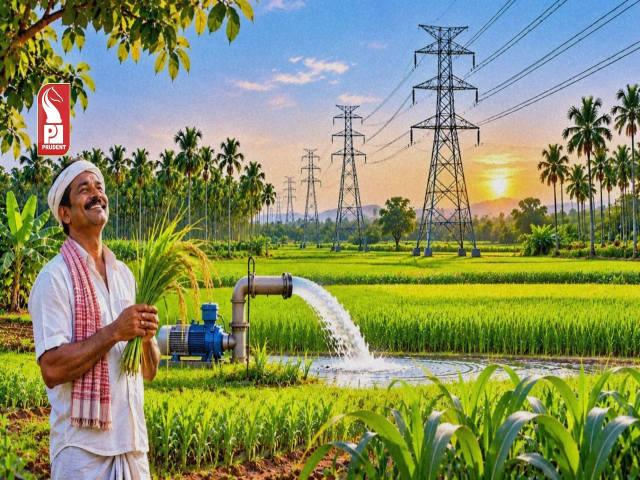
Agriculture remains the backbone of Karnataka's rural economy, supporting millions of farming families and sustaining livelihoods across districts such as Mysuru, Mandya, Chamarajanagar, Davangere, Tumakuru and Chitradurga. While agricultural policies, irrigation facilities, improved seeds and modern farming techniques have contributed to agricultural development, one critical requirement often receives less public attention: reliable electricity. For farmers who depend on electric pumps to irrigate their fields, the availability of electricity at the right time and at an adequate voltage can make a significant difference to crop productivity, income and overall livelihood security.
The government has taken important steps to support the farming community by providing free electricity for agricultural pump sets. This has reduced the financial burden on farmers and helped them access irrigation facilities without having to worry about the direct cost of electricity consumption. However, the real value of such a benefit depends on whether electricity can be delivered consistently and efficiently. Free electricity has limited practical value if farmers face frequent interruptions, inadequate voltage or uncertainty over supply schedules. This is where robust transmission and power infrastructure becomes essential.
Electricity is not simply another input in modern agriculture. It is directly connected to the daily functioning of a farm. From lifting groundwater and operating borewell pumps to maintaining irrigation systems and supporting post-harvest activities, dependable power is increasingly important. In regions where farmers depend heavily on borewells, even a few hours of disruption during critical irrigation periods can affect crop health. A delay in watering during flowering, fruit formation or other sensitive stages can have consequences for agricultural output.
The challenge becomes more pronounced during summer, when groundwater levels decline and irrigation requirements increase. Farmers growing sugarcane, paddy, vegetables, coconut, arecanut and horticultural crops require timely water supply to protect their investments. In the absence of reliable electricity, farmers may be forced to operate pumps during inconvenient hours, make repeated visits to their fields or depend on diesel-powered alternatives. These arrangements increase operational difficulties and, in many cases, add to the cost of cultivation.
The distinction between electricity generation and reliable supply
India has made considerable progress in expanding its electricity generation capacity, including through renewable energy sources such as solar and wind. Karnataka, in particular, has significant renewable energy potential. However, generating electricity and delivering it to consumers are two different aspects of the power system. Electricity must travel through an interconnected network of transmission lines and substations before reaching distribution networks and, ultimately, agricultural consumers.
This distinction is important when discussing the challenges faced by farmers. A state may have sufficient electricity generation capacity, but without adequate transmission infrastructure, the power system can face constraints in moving electricity from generation centres to areas where demand exists.
Transmission lines act as the connecting infrastructure between electricity generation and consumption. High-voltage networks carry bulk electricity over long distances, while substations help regulate voltage and facilitate the transfer of power between different levels of the network. The distribution system then delivers electricity to households, agricultural connections, commercial establishments and industries.
Each component has a specific role. Therefore, improving agricultural electricity supply requires attention not only to generation and distribution but also to strengthening the transmission network that supports the entire system.
Why Karnataka needs stronger transmission infrastructure
Karnataka's electricity requirements are evolving rapidly. Urbanisation, industrial expansion, irrigation demand and the growing use of electrical equipment are increasing pressure on the power system. At the same time, renewable energy projects are expanding across districts with favourable wind and solar resources.
Much of this renewable energy is generated away from major consumption centres. Moving this electricity efficiently requires a well-planned transmission network. Without adequate transmission capacity, available power may not always reach the areas where it is required, particularly during periods of high demand or when renewable generation fluctuates.
For agricultural regions, the strength of this network has long-term significance. A reliable grid supports the movement of electricity across regions, improves the ability of the system to respond to changing demand and creates opportunities to integrate additional generation capacity. It also provides the infrastructure required to support future agricultural electrification, rural enterprises and cold storage facilities.
The importance of this becomes evident in districts such as Mysuru and Mandya, where agriculture remains closely connected to the regional economy. Farmers cultivating paddy, sugarcane, coconut, vegetables and other crops depend on irrigation at different stages of cultivation. As agricultural practices become more technology-driven, electricity requirements will extend beyond conventional pump sets to include processing, storage, grading and other value-added activities.
Reliable electricity can also encourage the development of rural enterprises. Food processing units, milk chilling facilities, agricultural warehouses and cold chains require dependable power. These facilities help reduce post-harvest losses, improve the shelf life of agricultural produce and allow farmers to explore better market opportunities. Strong transmission infrastructure, supported by efficient distribution networks, therefore contributes to a much broader rural development agenda.
Transmission infrastructure is an investment in the future
The development of transmission infrastructure should not be viewed merely as a technical requirement of the electricity sector. It is a long-term investment in economic development.
A transmission line is designed to serve the power system for decades. Its benefits extend beyond the immediate villages or districts through which it passes. It strengthens connectivity between generation centres and consumption areas, supports industrial development, improves grid flexibility and creates the capacity needed for future electricity demand.
For Karnataka, which is simultaneously pursuing agricultural growth, industrialisation and renewable energy expansion, infrastructure planning must anticipate future requirements rather than respond only after supply constraints emerge.
This also makes timely execution of transmission projects important. Delays in land-related processes, route approvals, construction and commissioning can affect the pace at which the wider power network is strengthened. A coordinated approach involving government agencies, transmission utilities, local administrations and project developers is therefore necessary.
Addressing farmers' concerns through transparency and dialogue
At the same time, the need for stronger electricity infrastructure cannot be separated from the concerns of landowners and farming communities. Transmission projects often involve agricultural land, and farmers naturally seek clarity about tower locations, compensation, safety and the impact on cultivation.
These concerns deserve serious consideration. Infrastructure development should proceed through transparent consultation, proper documentation and adherence to applicable legal and regulatory provisions. Route planning should seek to minimise unnecessary impact on agricultural activity, while compensation and other statutory entitlements must be addressed fairly and within the prescribed framework.
It is equally important to distinguish between the land required for tower foundations and the wider transmission corridor. In many cases, agricultural cultivation can continue beneath transmission lines, subject to applicable safety clearances and restrictions. Explaining these technical aspects in simple language can help address misunderstandings and enable more informed discussions between project authorities and affected communities.
Local administrations and project developers must maintain regular communication with farmers, provide accessible information and establish effective mechanisms for addressing grievances. Public trust is essential for the successful development of infrastructure that serves a wider public interest.
Powering agriculture requires a stronger electricity network
The future of agriculture will increasingly depend on the availability of reliable infrastructure. Water management, mechanisation, food processing and modern farming practices all require dependable electricity. As climate variability places additional pressure on water resources, farmers will need efficient irrigation systems and better access to power to manage their crops.
Providing free electricity to agricultural consumers is an important welfare measure. However, the objective should extend beyond the provision of subsidised power. Farmers must also be able to access electricity with adequate reliability and quality, within the applicable supply schedules. This requires continuous improvement across generation, transmission and distribution.
The development of transmission infrastructure is therefore not an isolated activity undertaken by the power sector. It is closely linked to the state's agricultural productivity, rural employment, industrial competitiveness and economic progress.
For a state like Karnataka, strengthening the electricity network is a necessity, not merely an option. Every additional transmission corridor and upgraded substation contributes to building a power system capable of meeting tomorrow's requirements. The benefits may not always be immediately visible, but they are reflected in a stronger grid, improved electricity connectivity and greater capacity to support economic activity.
Ultimately, the objective of power infrastructure development must be to ensure that electricity generated in one part of the state can reliably reach the farmers, households and industries that need it elsewhere. For Karnataka's agricultural communities, a stronger transmission network is not just about moving electricity across long distances. It is about protecting crops, supporting livelihoods, improving rural opportunities and creating the foundation for sustainable agricultural growth.

